• Home
  • About

Russian Black Sea Fleet on a Parade in 1849, by Ivan Aivazovsky

Published in April 12th, 2010
Posted by admin in 19th Century, Russian Navy
No Comments

Russian Black Sea Fleet on a Parade

Russian Black Sea Fleet on a Parade in 1849, by Ivan Aivazovsky, 1886

Central Naval Museum of Russia in Saint Petersburg

(image 2103×1200 pixels 412KB)

Russian Black Sea Fleet ships of the line on a parade – an impressive display of naval might captured by Ivan Aivazovsky in the last years of the sailing warship’s rule over the seas. In 1849 Emperor Nicolas I of Russia was reviewing his forces in the Black Sea. At that time the Black Sea Fleet was the most potent, most well organized, trained and technically advanced force in the arsenal of the Russian Empire. This achievement is owed much to Admiral Lazarev, commander of the Black Sea Fleet in 1834-51. In the years of his administration he had significantly improved the organization and personnel training; and the fleet had been receiving as much modern weapons and technology as limited Russian industry’s resources could allow. Under his tutorship a number of talented and energetic offices raised to prominence: Admirals Kornilov, Nakhimov, Istomin and Butakov.

The results of Admirals Lazarev’s work are clearly seen on this painting. The line is headed by 120-gun Twelve Apostles, the most modern ship of the fleet launched in 1841 and armed with shell guns. Behind him are 84-gun Rostislav, Svyatoslav and Yagudiil, 120-gun Tri Svyatitelya, and presumably 84-gun Gavriil, Selafail and  Uriil. The observer finds himself on board of paddle frigate Vladimir, one of the few steam powered ships in the fleet. The officers on deck are Emperor Nicolas I, Rear-Admiral Kornilov (Head of the Fleet Staff),  Grand Duke Constantine (Emperor’s brother), Rear-Admiral Berkh (Commander of the Sebastopol naval base)  and Admiral Lazarev (Commander of the Fleet).

Some of the ships shown here later had successfully fought the Turks in the Battle of Sinop but none of them survived the Crimean war. The rapid technology progress made the sailing ship of the line obsolete. Steam powered warships of Britain and France no longer depended on ever changing winds, and any attempt of Russian ships to confront them would have been suicidal. The tactical advantage of maneuvering under steam proved to be of a strategic value: after Sinop there were no more major engagements involving purely sailing warships.  These graceful ships ended up scuttled on the bottom of the Bay of Sebastopol.

This painting is on display in the Central Naval Museum of Russia, Saint Petersburg.

continue reading.....

Battle of Sinop (The Day), 18 November 1853

Published in April 29th, 2009
Posted by admin in 19th Century, Battle Scenes, Russian Navy
1 Comment
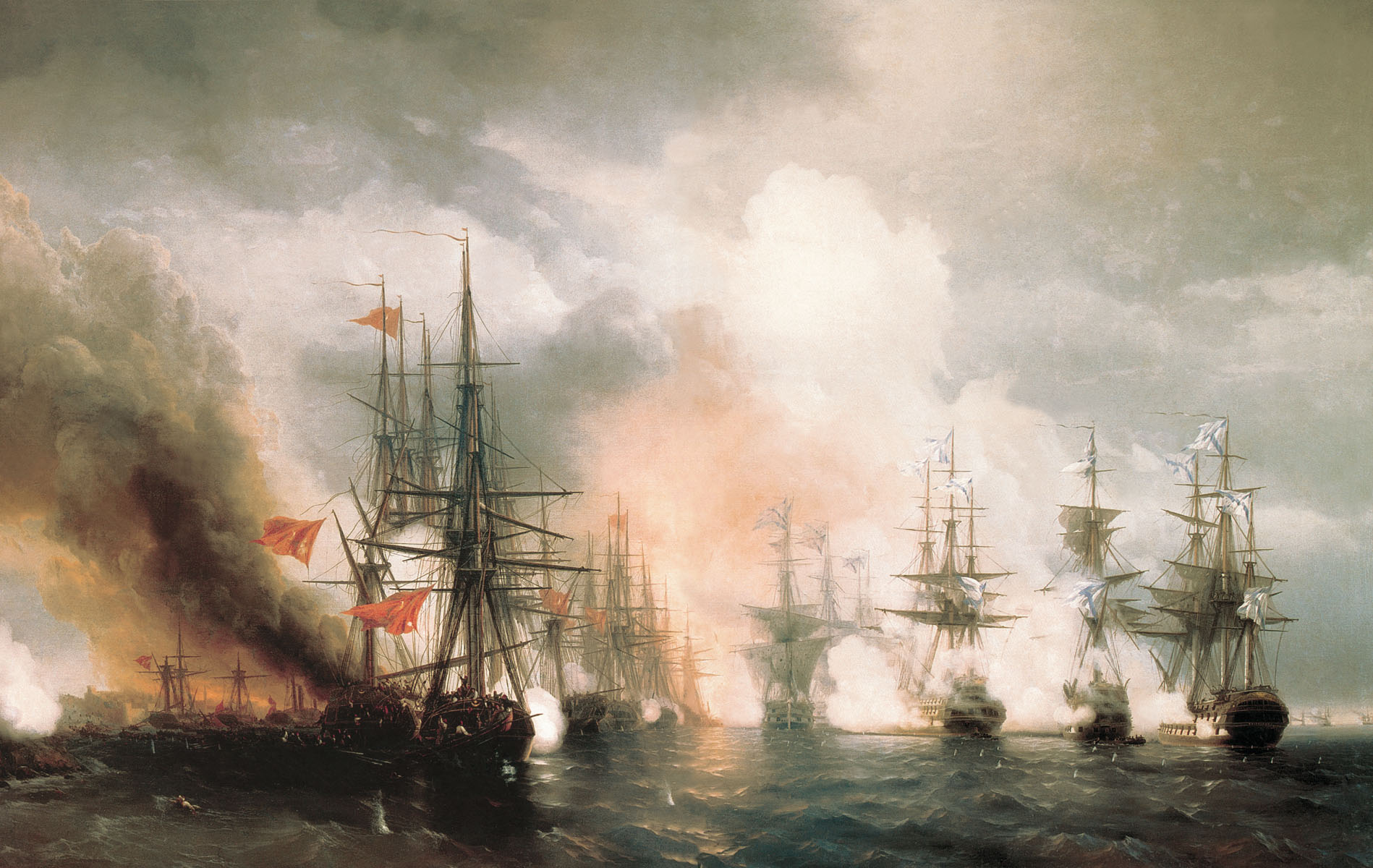
Battle of Sinop (The Day)

Battle of Sinop (The Day)

By Ivan Aivazovsky

The last major naval engagement of the age of sail (Battle of Sinop) can be seen on this painting by Ivan Aivazovsky. In November 1853 a Russian squadron commanded by Vice-Admiral Pavel Nakhimov (3 84-gun ships) was on patrol off the northern coast of Anatolia. Russian ships approached the Bay of Sinop to check the rumors of the Turks gathering a landing force there. A squadron of 7 Turkish frigates and 5 smaller ships was anchored in the bay protected by 6 coastal batteries. Nakhimov’s force blockaded the port and waited for reinforcements to come. Soon 3 120-gun ships of the line and 2 frigates commanded by Rear-Admiral Novosilsky joined Nakhimov. Fearing that the Anglo-French fleet might reinforce the Turks the Russians decided to attack.

The Russian fleet sailed down to Sinop in two columns. The ships of the line were armed with a new and formidable weapon: the Paixan 68-pounder shell guns, which were especially deadly against wooden warships. On 18 (30) November 12:30 PM the action began. The Russians took position in a crescent along the anchored Turkish ships and started firing. A fierce cannonade from the Turkish batteries and ships inflicted some serious damage on the Russian fleet, but still the Turkish frigates were no match to the shellfire of the bigger guns of the Russian ships of the line.  In slightly more than an hour all the Turkish ships were either destroyed or ran aground. By 4 PM the batteries were silenced as well. Only one Turkish steamer escaped the carnage.
continue reading.....

Battle of the Chios Straits (Prelude to the Battle of Chesma) July 5th (June 24th) 1770

Published in April 4th, 2009
Posted by admin in 18th Century, Battle Scenes, Russian Navy
No Comments

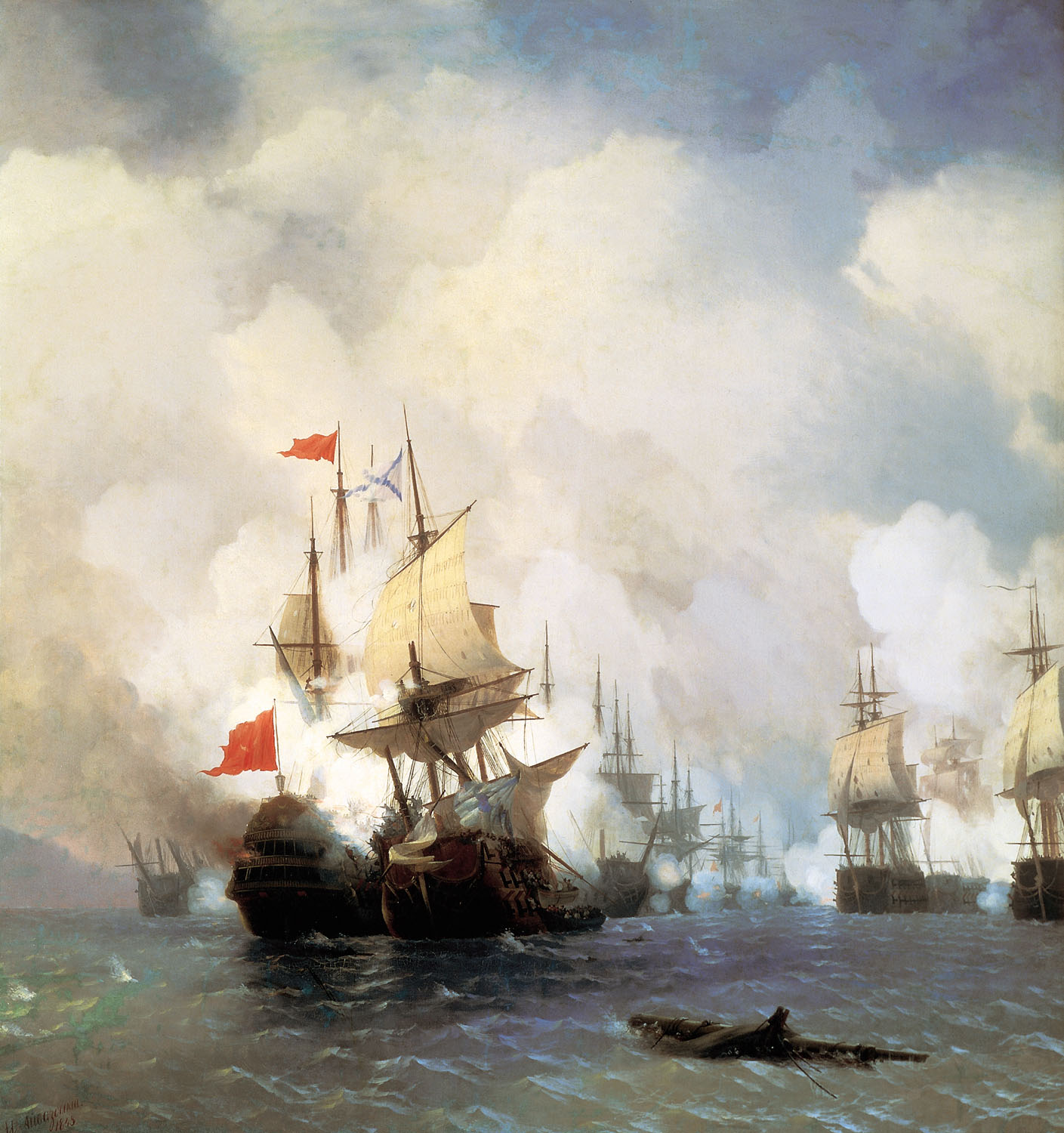
Battle of the Chios Straits July 5th 1770

By Ivan Aivazovsky. 1848

This painting depicts the duel between the turkish flagship Real Mustafa (84 guns) and russian admiral Spiridov’s ship Svyatoy Evstafiy (68). During the boarding action the burning debris of the turkish ship set the russian flagship on fire and soon she blew up. The russian admiral escaped the explosion just minutes before. Ten minutes later Real Mustafa exploded too. The turkish squandron retreated to the Bay of Chesma only to be destroyed there in the next two days in what later to be called Battle of Chesma.

Russian painter Ivan Aivazovsky dedicated a number of his works to this battle. This one was painted in 1848.

continue reading.....

Social Network

  • Subscribe to the feed
  • Stumble this site main post
  • Add to my Technorati favourite

Feeds

18th Century, Battle Scenes, and Russian Navy
February 2012
M T W T F S S
« Feb    
 12345
6789101112
13141516171819
20212223242526
272829  

Recent Entries

  • Boats in a Harbour and a Yacht Sailing Away by Willem van de Velde the Younger
  • The Merchant Shipping Anchorage Southwest of Texel, by Ludolph Backhuysen
  • Ships in the Roads of Amsterdam by Ludolph Backhuysen
  • The Loss of the Royal George by John Christian Schetky
  • The Bombardment of Algiers 27 August 1816 by George Chambers, Senior
  • The Explosion of the Spanish Flagship in the Battle of Gibraltar April 25th 1607 by Cornelis Claesz van Wieringen
  • Dutch Whalers off a Rocky Coast
  • The Dutch Fleet under Sail
  • The Eendracht and a Dutch Fleet of Men-of-War before the Wind
  • The Capture of Puerto Bello, 21 November 1739 by George Chambers, Senior 1836

Recent Comments

  • Danny in The First Post And The First Painti…
  • Anzoh in The Dutch Fleet under Sail
  • Heat in Harrison's H4 Chronometer, 1760
  • anzoh in The 'Gouden Leeuw' at the Battle of…
  • admin in The Loss of the Royal George by Joh…
  • Theo in The Loss of the Royal George by Joh…
  • dutchprovence in Dutch Whalers off a Rocky Coast
  • Anonym in Harrison's H4 Chronometer, 1760
  • Capt. John Wood… in Battle of Livorno (Leghorn), March …
  • » The Bom… in The Capture of Puerto Bello, 21 Nov…

Categories

    • 17th Century
    • 18th Century
    • 19th Century
    • Battle Scenes
    • Drawings
    • Dutch Navy
    • First Anglo-Dutch War
    • French Navy
    • French Revolutionary War
    • Harbors
    • Ludolf Backhuysen
    • Portraits
    • Royal Navy
    • Russian Navy
    • Second Anglo-Dutch War (1664–67)
    • Seven Years War
    • Third Anglo-Dutch War
    • Uncategorized
    • Unidentified Paintings
    • War of American Independence
    • Willem van de Velde the Elder
    • Willem van de Velde the Younger

Translators

French German version Spanish version Italian version

Blogroll

  • marine oil paintings - marine oil paintings
©2009 History of the Sailing Warship in the Marine Art