• Home
  • About

The Battle of the Saintes, 12 April 1782

Published in March 13th, 2010
Posted by admin in 18th Century, Battle Scenes, French Navy, Royal Navy, War of American Independence
No Comments

the-battle-of-the-saints-12-april-1782-by-thomas-mitchell-1782

The Battle of the Saintes, 12 April 1782 by Thomas Mitchell, 1782

National Maritime Museum Greenwich

(image 4000×2559 pixels, 10MB)

The Battle of the Saintes was fought between French and English fleets in April 1782 as a part of the conflict ensued after the rebellion in the Thirteen Colonies. A series of engagements took place starting April 9th with the decisive action fought on April 12th. The name Saintes comes from a group of islands between Guadeloupe and Dominica in the West Indies.

In the early 1782 the French and the Spanish had planned a joint invasion of Jamaica. The French fleet consisting of 35 ships of the line commanded by Comte de Grasse sailed on April 8th from Martinique accompanied by a large troop convoy to meet the Spanish forces off Cap François. Admiral Sir George Rodney, commander of the English fleet of thirty-seven ships, followed at once. With a little wind the fleets have been maneuvering and skirmishing for four days. Hectic maneuvers resulted in a number of collisions in the French fleet that cost it ships and time. Finally in one of those collisions Zelé, commanded by Captain Gras-Previllé, was dismasted which brought on the main battle on April 12th.

The two fleets were passing in line on opposite course cowered in the thick smoke from the cannon. A sudden shift in the wind threw both lines into disorder with some of the British ships crossing the French line. This ‘breaking the line’ much praised later as a brilliant tactical maneuver was in fact unintentional and unfortunate. The British ships around the French flagship were cut and surrounded. The bulk of the French fleet, however, was trapped between the British and the shore and could not escape. In the melee that followed five French ships were taken including the flagship Ville de Paris with Comte De Grasse himself.

Admiral Hood, the second in command of the British fleet, insisted on pursuing of the remaining French ships but the exhausted Rodney who did not sleep for the last four days refused. Still Hood had managed to take two escapees later and the French plans of the invasion of Jamaica were thwarted.

In the middle of the painting the French flagship Ville de Paris, 104, is shown hauling down her colors with the Rodney’s flagship Formidable, 98, engaging her from the starboard. Beyond the Ville de Paris the British Barfleur, 98, is seen raking her from the bow. In the reality Ville de Paris surrendered to Admiral Hood, not to Rodney. The painting correctly shows the British ships flying red ensigns, despite the fact that Rodney was Admiral of the White (note the St. George flag on the main mast of the Formidable).  This was the result of Rodney’s order to avoid confusion with the white Bourbon ensigns of the French.

Source ID: #fghtshpsv2#

continue reading.....

The Occupation of Newport, 9 December 1776

Published in May 30th, 2008
Posted by admin in 18th Century, Royal Navy, War of American Independence
1 Comment

The Occupation of Newport, 9 December 1776

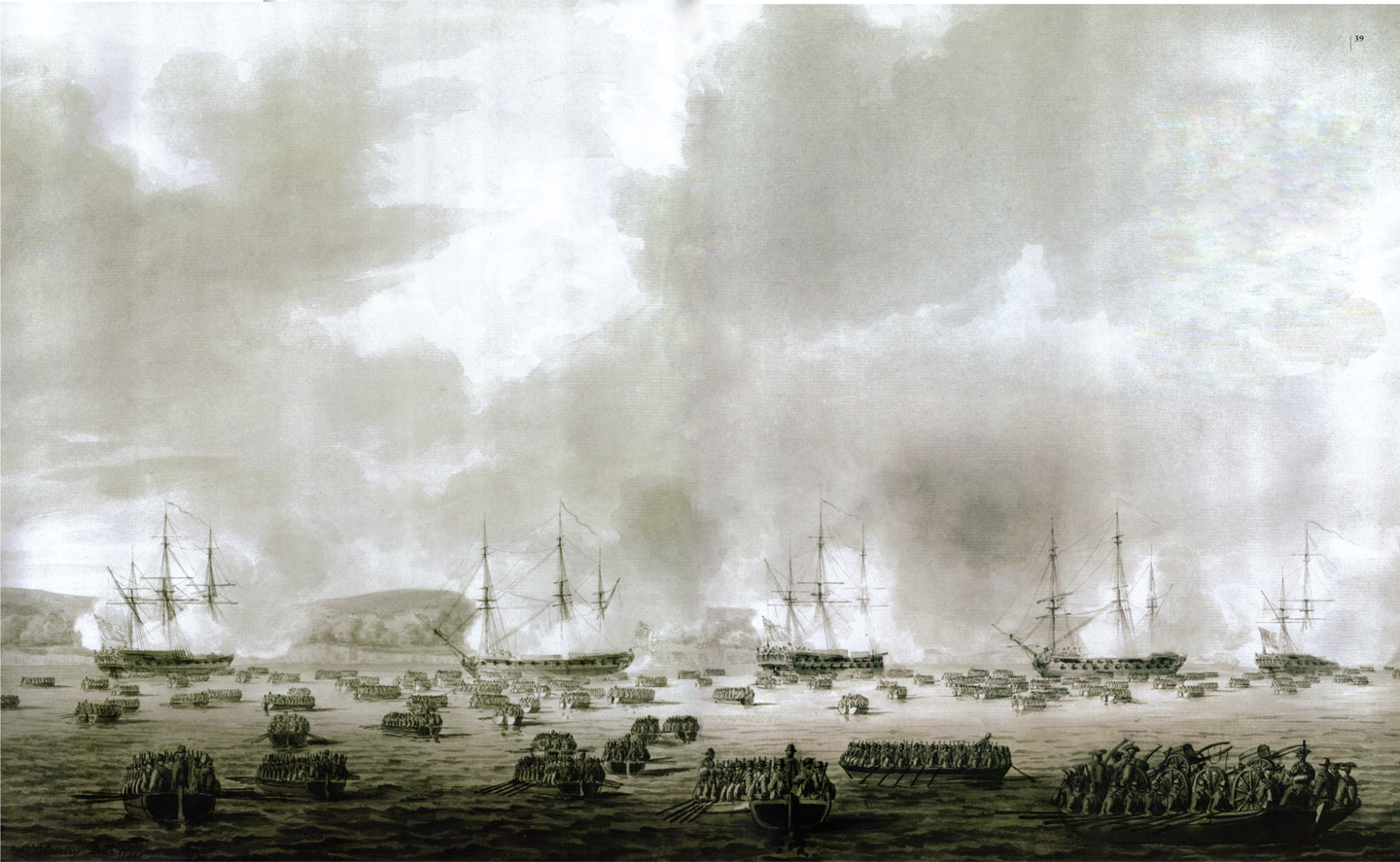
THE OCCUPATION OF NEWPORT, 9 DECEMBER 1776

By Robert Cleveley, 1777

(Highest resolution available 8165×5030)

In 1775 the 13 British colonies in North America rebelled against British rule and formally proclaimed their independence as the United States of America. What started as a war for America soon became a war for global maritime predominance. It differed in a number of significant factors from the Seven Years War, however. Firstly, Spain allied with France in 1779 and their combined navies were larger than that of the British. Secondly, the maritime war was conducted in Americas, thousands miles away from any quality dockyard resources. The Royal Navy’s successes in the Western Approaches in the Seven Years War had been largely achieved through easy access to the high-quality dockyards of the south and southwest coast of Britain. Crucially these had dry docks where the ships’ bottoms could be maintained and cleaned. In the coming war, however, that advantage was lost. Moreover, the War of American Independence came after nearly a decade of peace. In peacetime the ships had been laid up and the sailors and officers laid off, but to practise naval warfare at a high level required constant practice. Efficient sail handling and gunnery required crews to be drilled regularly; maneuvering the fleet required months of practice of each captain was to be able to regulate his position in relation to others be eye; and the repair pf damage caused by enemy fire or the weather was another skill that could be learned in dock. With no explicit and detailed policy to maintain operational effectiveness, rustiness had grown in Britain as quickly as complacency. The French and Spanish, meanwhile, had been steadily growing and modernizing their navies. In the coming war the Royal Navy was to receive a terrible shock.
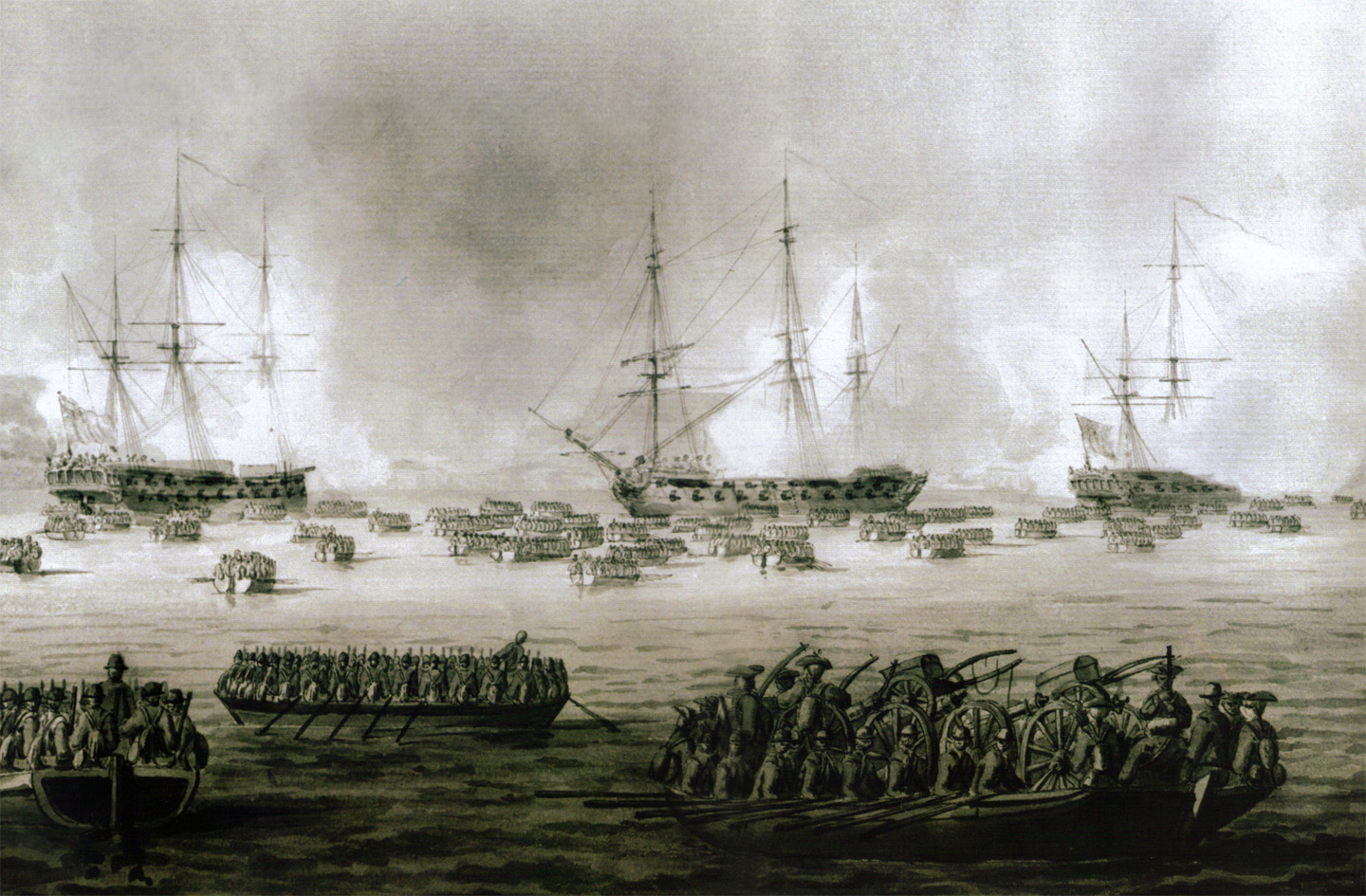
The Occupation of Newprt, 9 December 1776, Fragment

THE OCCUPATION OF NEWPORT, 9 DECEMBER 1776. (Fragment)

When the war came, the Royal Navy used its experience in successful amphibious assaults of the previous war, among others, Québec and Havana to attack the rebels in their heartland. New York was a rebel stronghold and the most important commercial center in North America. To provide and alternative naval base to New York, Newport, Rhode Island, was also targeted, and the landing is shown in this image. The artist, Robert Cleveley, was an eyewitness to the assault, serving as captain’s clerk aboard the Asia. Both the attacks on New York and Rhode Island were great successes. The ships in the background can be seen laying down a covering bombardment while the boats pull for the beach. The boats in this image were specially designed landing craft known as ‘flatboats’. They could be stacked on board troopships, and once assembled and launched they could carry two rows of troops facing inward down the center, or artillery as is shown in the foreground to the right.

Source ID: #fghtshpsv2#

continue reading.....

Between the Seven Years War and the American Revolution

Published in May 30th, 2008
Posted by admin in 18th Century, Royal Navy, War of American Independence
No Comments

The hostilities of the Seven Years War were ended in 1763 by the Treaty of Paris. This involved a complex series of land exchanges but it was quite clear that Britain had won an astounding victory through her successful use of sea power: Canada and India were now British colonies. Much had been learned by both sides during the war about the difficulties of maintaining and operating fleets of fighting ships and, crucially, about the defense of the British Isles from invasion. By 1763 invasion was a significant part of French strategy for almost 20 years. Although the English Channel is at its narrowest point only 21 miles wide, significant logistical factors worked against the French. To start with, there were no major French ports anywhere along the Channel. The nearest port that could hold an invasion fleet and the necessary warships to protect it was at Brest, facing the Atlantic on the western coast of Brittany. To launch an invasion across the Channel, the cumbersome and unarmed invasion craft would either have to make the journey alone, unprotected from strong British forces awaiting them on sea and land, or would have to wait for fleet of warships to escort them across. It was, however, exceptionally dangerous for a fleet of French warships to enter the Channel. Not only there were no French ports safe from the weather or from English attack, but escape from the Channel back towards Brest could not be guaranteed in the face of prevailing westerly winds.

For that reason a British squadron watching the Western Approaches to the Channel could protect Britain from invasion and, in the same time, both protect her own trade and attack that of the French. Thus was born the Western Squadron which was to prove highly effective in maintaining a permanent and close blockade of the French coast. The relentlessness of that blockade was made possible by significant administrative and logistical developments; not least the revictualling of the fleet at sea which allowed ships to stay on station, with healthy crews, indefinitely. This close blockade of the French ports not only countered the invasion threat but also squeezed the life out of the French navy and of the entire French war effort. Sailors were denied sea time; the port was denied stores; and the French war machine in turn was denied money as the private financiers who kept the French economy afloat were crippled by British success against French trade.

Maintaining the blockade forged a generation of officers and men who had learned their trade in the unforgiving conditions of the Bay of Biscay and in the harsh reality of combat. Moreover, the execution of Admiral Byng for failing to do his duty at the Battle of Minorca in 1756 strengthened the professional resolve of naval officers so that, at the Battle of Quiberon Bay in 1759, Hawke was able to demonstrate what was possible if healthy, dedicated and skilled sailors were well led.

Great technological breakthroughs had also been made. Of these the most significant was the emergence of the 74-gun ship as the backbone of every nation’s fleet. The 74 was large enough and had a significant weight of broadside to lie in the line of the battle alongside 100-gun ships of three decks, but she was also quick and maneuverable; a perfect compromise between the handiness of a frigate and the strength of a line of battle ship. Little progress was made regarding fleet tactics, however. Quiberon Bay had been a resounding success but the battle had been a chaotic melee, fought in a chase, and the French had not expected or desired battle. A number of actions had been fought in India in which both fleets had sought battle, but they again had proved indecisive affairs with both fleets fighting in parallel line ahead. The line of battle, like trench warfare, was far stronger in defense than attack and as yet no fleet was prepared to take the risks necessary to break it.

Source ID: #fghtshpsv2#

continue reading.....

Social Network

  • Subscribe to the feed
  • Stumble this site main post
  • Add to my Technorati favourite

Feeds

18th Century, Royal Navy, and War of American Independence
May 2013
M T W T F S S
« Apr    
 12345
6789101112
13141516171819
20212223242526
2728293031  

Recent Entries

  • An English Ship with Sails Loosened Firing a Gun, by Peter Monamy
  • Two Engravings by Ludolf Bakhuizen
  • Boats in a Harbour and a Yacht Sailing Away by Willem van de Velde the Younger
  • The Merchant Shipping Anchorage Southwest of Texel, by Ludolph Backhuysen
  • Ships in the Roads of Amsterdam by Ludolph Backhuysen
  • The Loss of the Royal George by John Christian Schetky
  • The Bombardment of Algiers 27 August 1816 by George Chambers, Senior
  • The Explosion of the Spanish Flagship in the Battle of Gibraltar April 25th 1607 by Cornelis Claesz van Wieringen
  • Dutch Whalers off a Rocky Coast
  • The Dutch Fleet under Sail

Recent Comments

  • amberlu in The Victory Leaving the Channel in …
  • admin in The Merchant Shipping Anchorage Sou…
  • nescio in The Merchant Shipping Anchorage Sou…
  • Bettylene W. Fr… in Harrison's H4 Chronometer, 1760
  • ernie in The Raid on Chatham (Raid on Medway…
  • Diana Barron in Boats in a Harbour and a Yacht Sail…
  • kepler in The surrender of Prince Royal at th…
  • Bizuvnot in A Dutch Flagship Coming to Anchor w…
  • Bizuvnot in A Ship in High Seas Caught by a Squ…
  • grampahoney in A Ship in High Seas Caught by a Squ…

Categories

    • 17th Century
    • 18th Century
    • 19th Century
    • Battle Scenes
    • Drawings
    • Dutch Navy
    • First Anglo-Dutch War
    • French Navy
    • French Revolutionary War
    • Harbors
    • Ludolf Backhuysen
    • Portraits
    • Royal Navy
    • Russian Navy
    • Second Anglo-Dutch War (1664–67)
    • Seven Years War
    • Third Anglo-Dutch War
    • Uncategorized
    • Unidentified Paintings
    • War of American Independence
    • Willem van de Velde the Elder
    • Willem van de Velde the Younger

Translators

French German version Spanish version Italian version

Blogroll

  • marine oil paintings - marine oil paintings
©2008 History of the Sailing Warship in the Marine Art