• Home
  • About

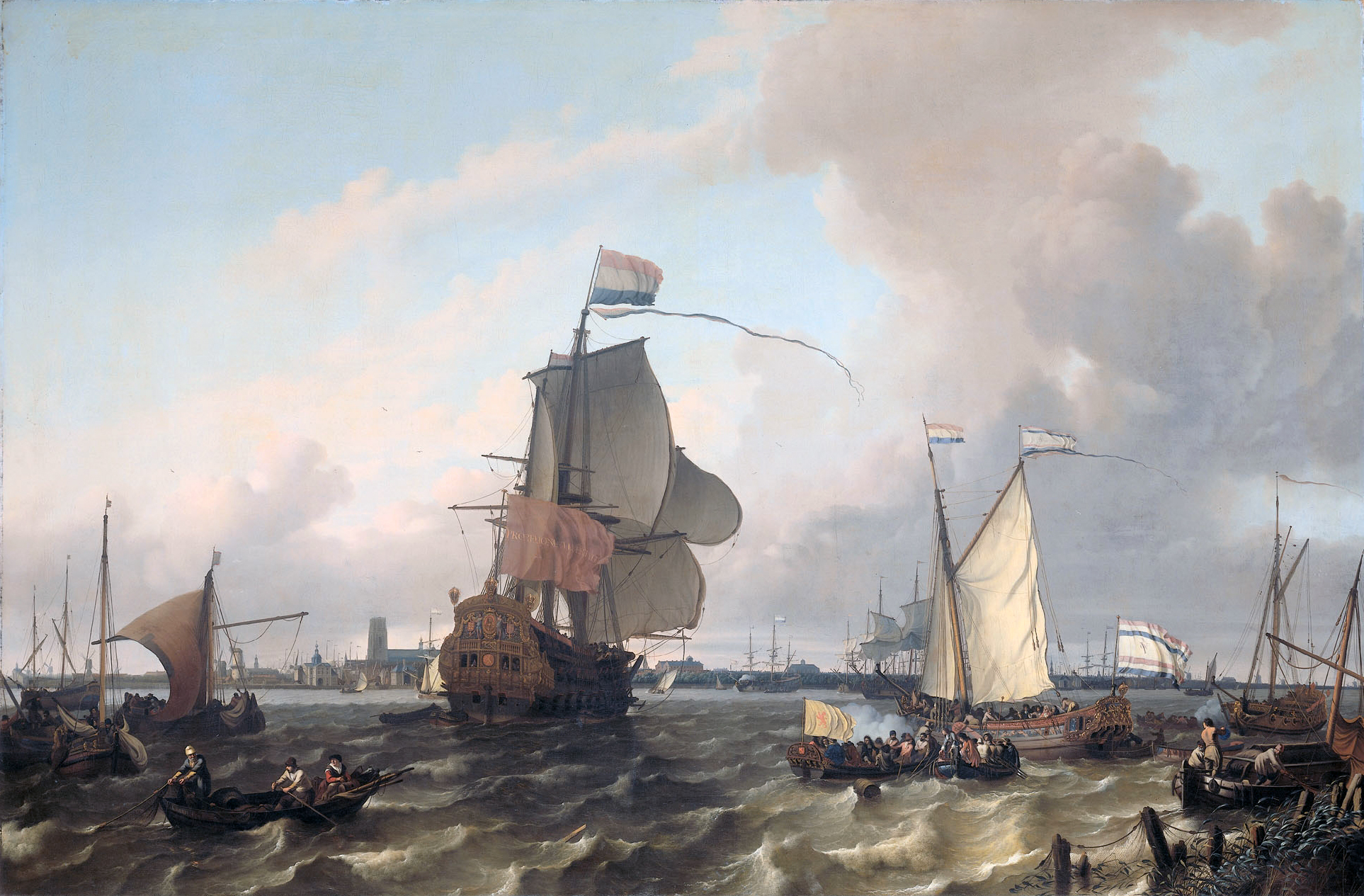
The Warship ‘Brielle’ on the Maas before Rotterdam

Published in April 21st, 2009
Posted by admin in 17th Century, Dutch Navy, Harbors, Ludolf Backhuysen
No Comments
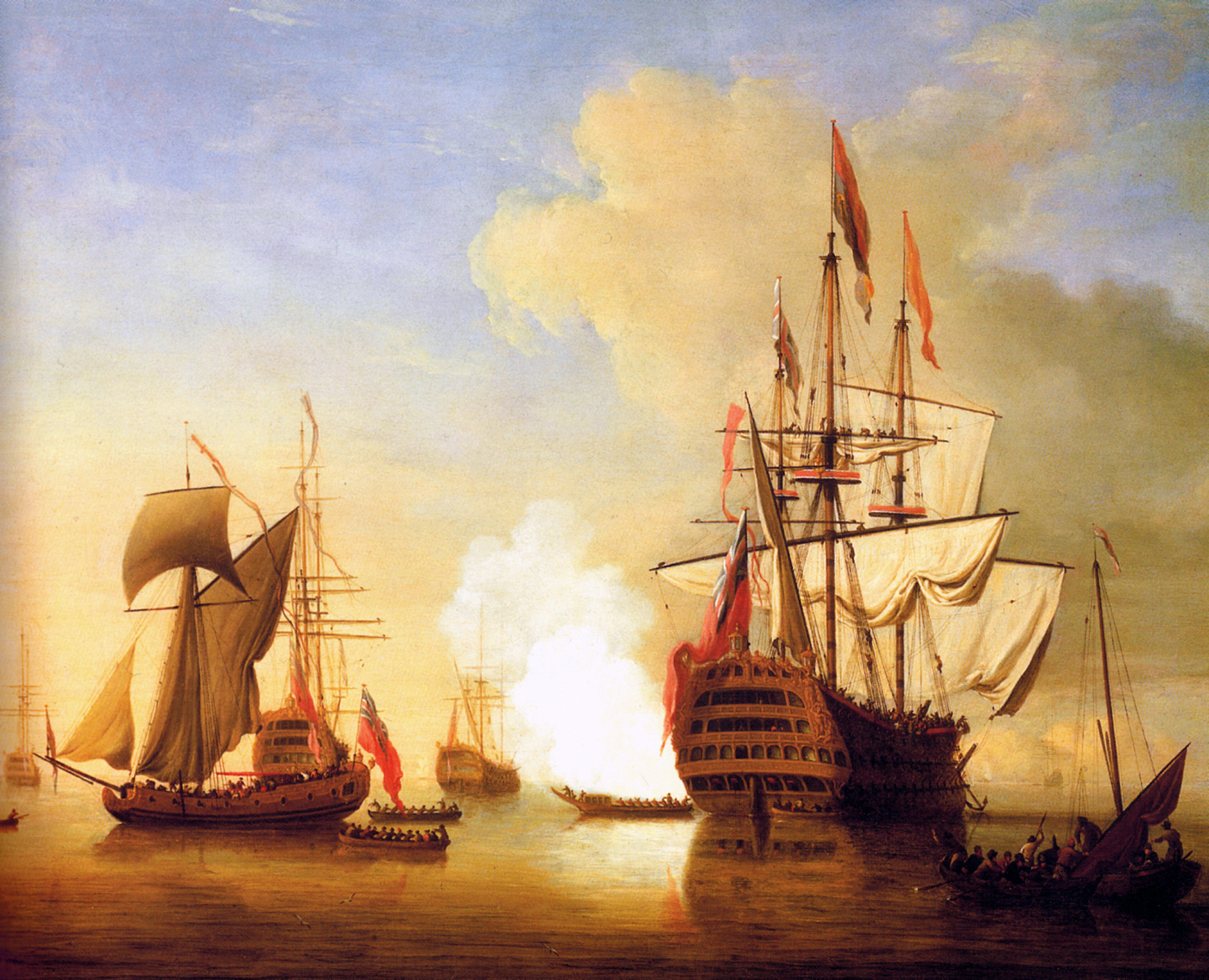
The Warship Briele on the Maas before Rotterdam

The Warship Briele on the Maas before Rotterdam

By Ludolf  Bakhuysen, 1689

Rijksmuseum Amsterdam

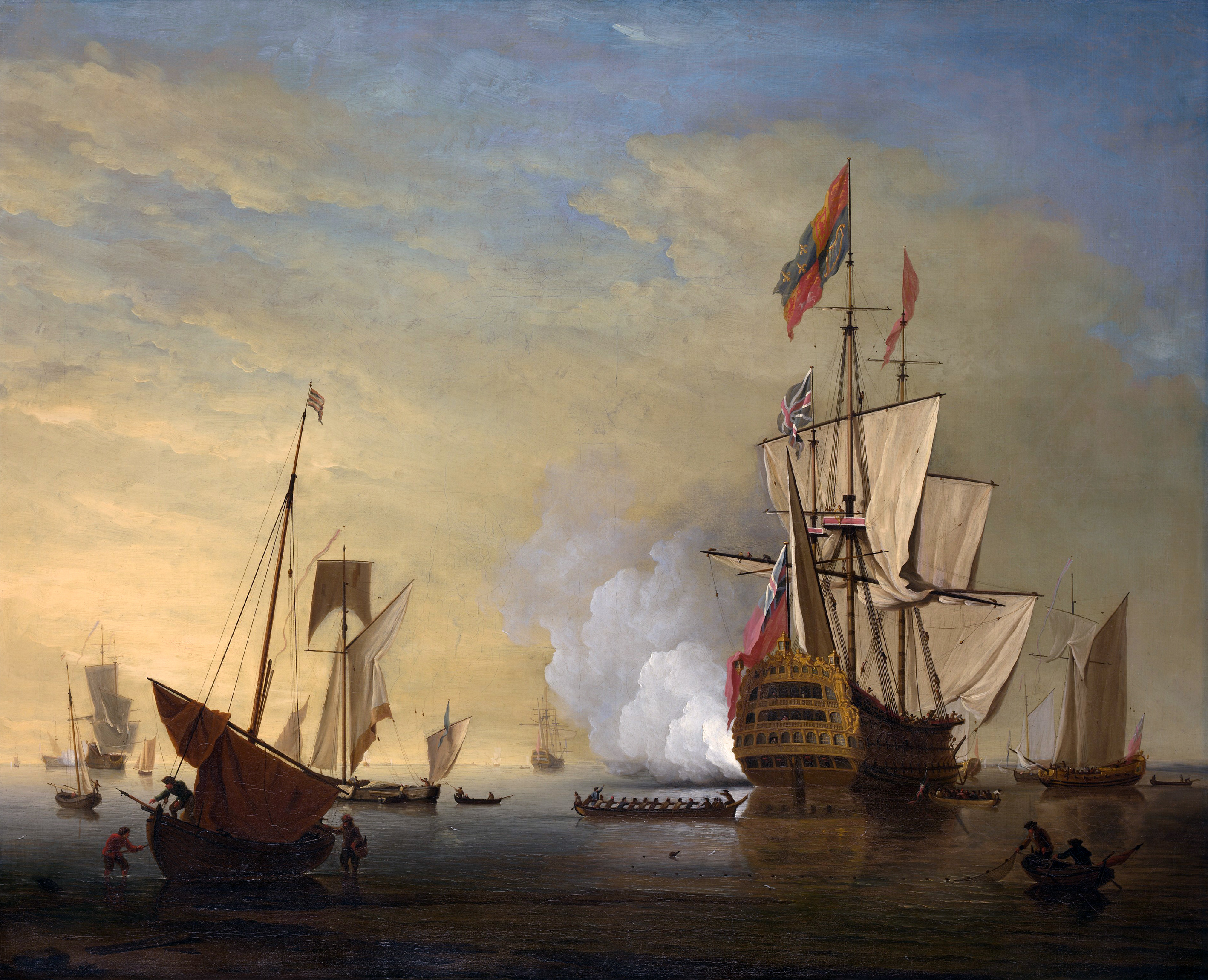
In the center of this painting is the Brielle, a 50-gun warship sailing by the Admiralty Buildings in Rotterdam. Her stern is decorated with a shield bearing the portrait of William III, Prince of Orange, with arms of England and Scotland on either side. The main mast is flying the flag of the Prince and a splitted pennant. To the right is a VOC yacht (possibly with Princess Mary, the Prince’s wife, on board) firing a salute. Two boats are accompanying the yacht, one of them is under the flag of the States-General. In the background one can see Rotterdam: the western and the eastern New Main Gate to the Leuvehaven, the St. Lawrence Church, City Hall and the old warehouse of the Admiralty.

continue reading.....

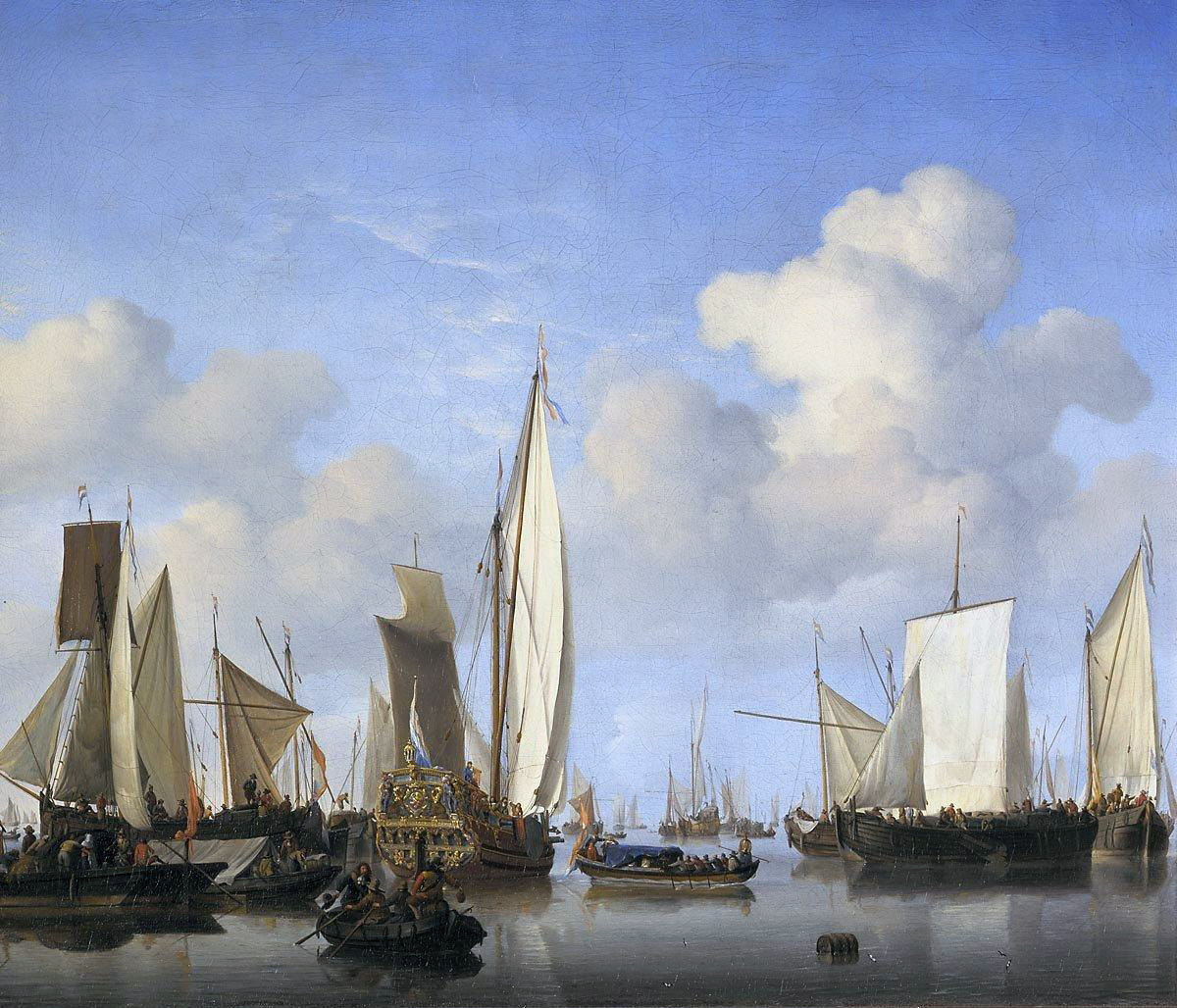
Ships on the Roadstead, 1658

Published in April 14th, 2009
Posted by admin in 17th Century, Dutch Navy, Harbors, Willem van de Velde the Younger
No Comments
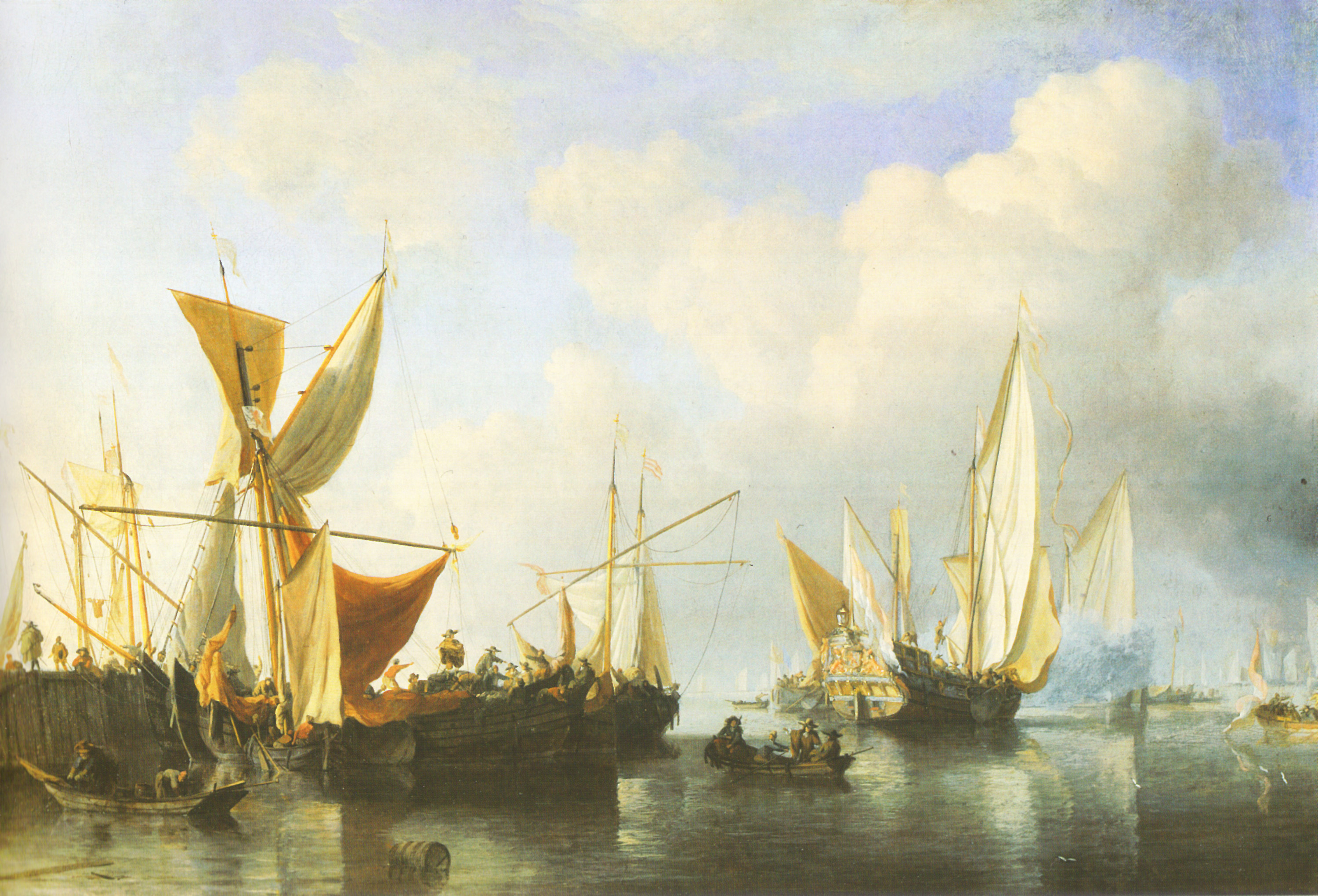
Schepen op de rede (Ships on the Roadstead)

Schepen op de rede (Ships on the Roadstead)

By Willem van de Velde the Younger, 1658

This work by Willem van de Velde displays a calm scene of Dutch merchant and fishing vessels on a roadstead in a still weather. In the middle of the painting a yacht with a richly decorated stern  dominates the scene while small boats shuffle goods and passengers between humble looking merchant ships.

continue reading.....

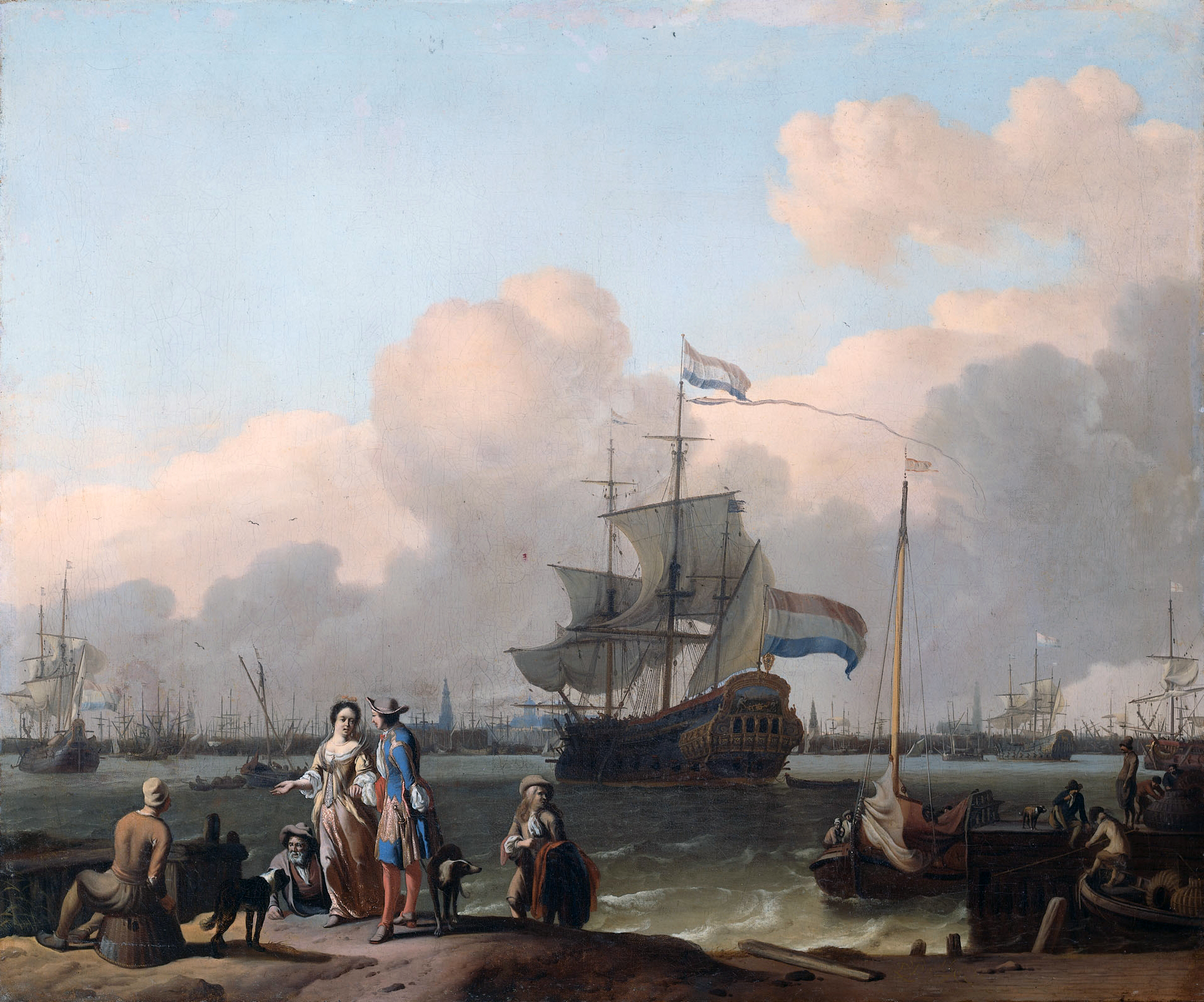
The Frigate “De Ploeg” on the Ij in Amsterdam

Published in April 13th, 2009
Posted by admin in 17th Century, Dutch Navy, Harbors, Ludolf Backhuysen
1 Comment
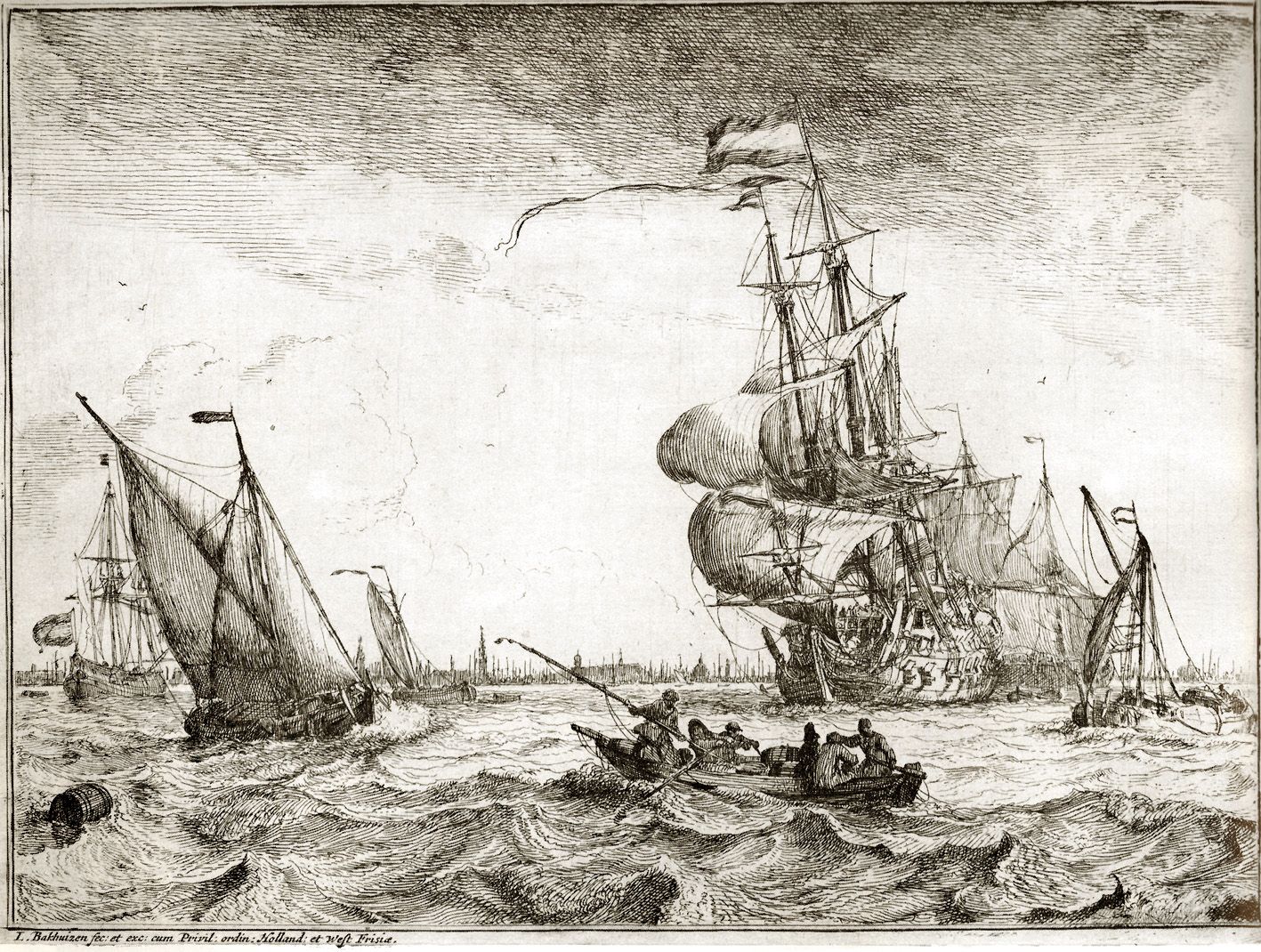
The Frigate "De Ploeg" on the Ij in Amsterdam

The Frigate "De Ploeg" on the Ij in Amsterdam

By Ludolf Bakhuizen (ca. 1685-1695)

Rijksmuseum Amsterdam

The Ij is a river, formerly a bay, that is known for being Amsterdam’s waterfront. On this painting Amsterdam is seen in the background behind merchant vessels and men of war including the frigate De Ploeg in the front.

continue reading.....

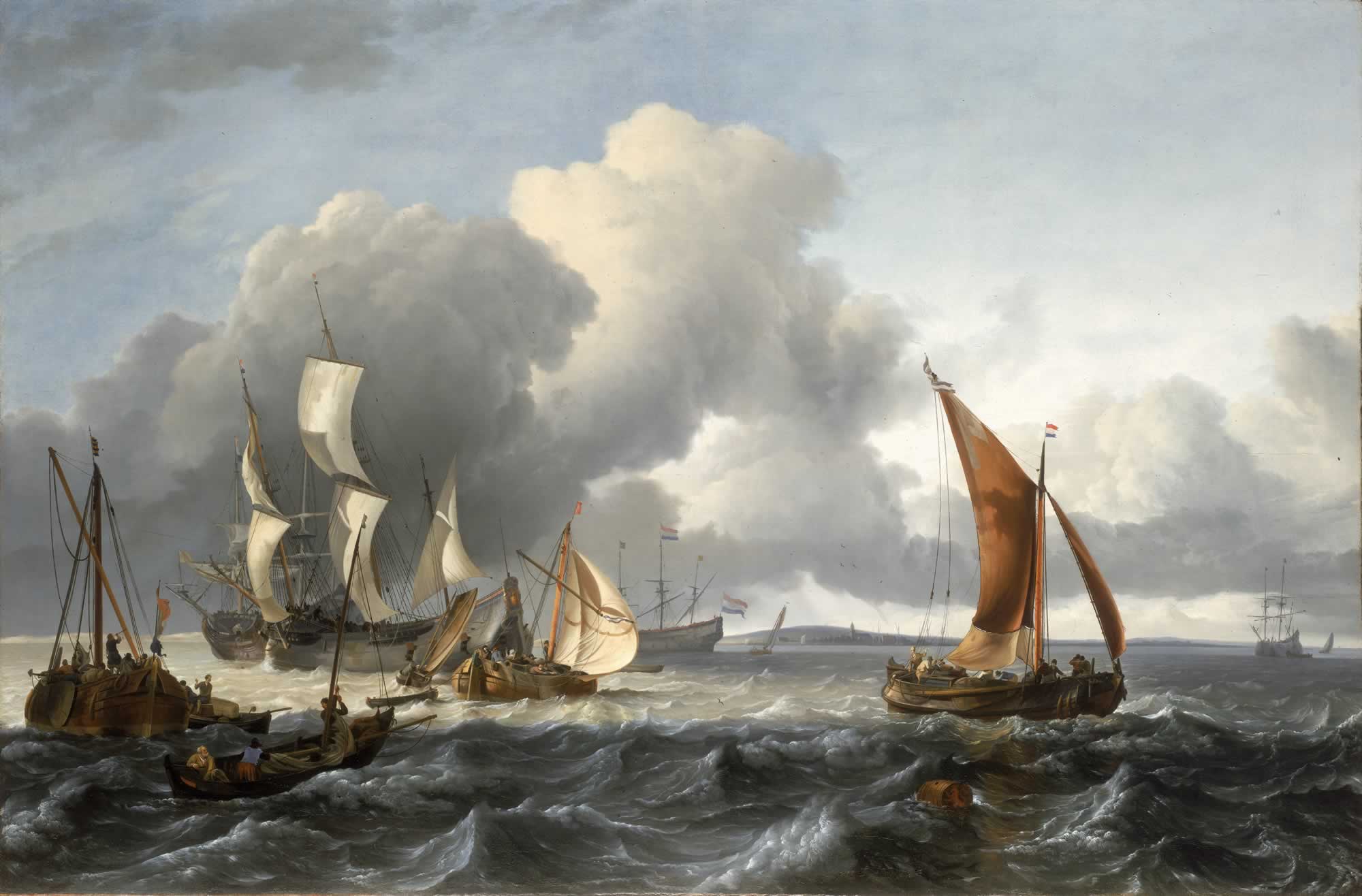
The Merchant Shipping Anchorage in the Texel with Texel Island and Oude Schild to the North West

Published in April 12th, 2009
Posted by admin in 17th Century, Dutch Navy, Harbors, Ludolf Backhuysen
No Comments
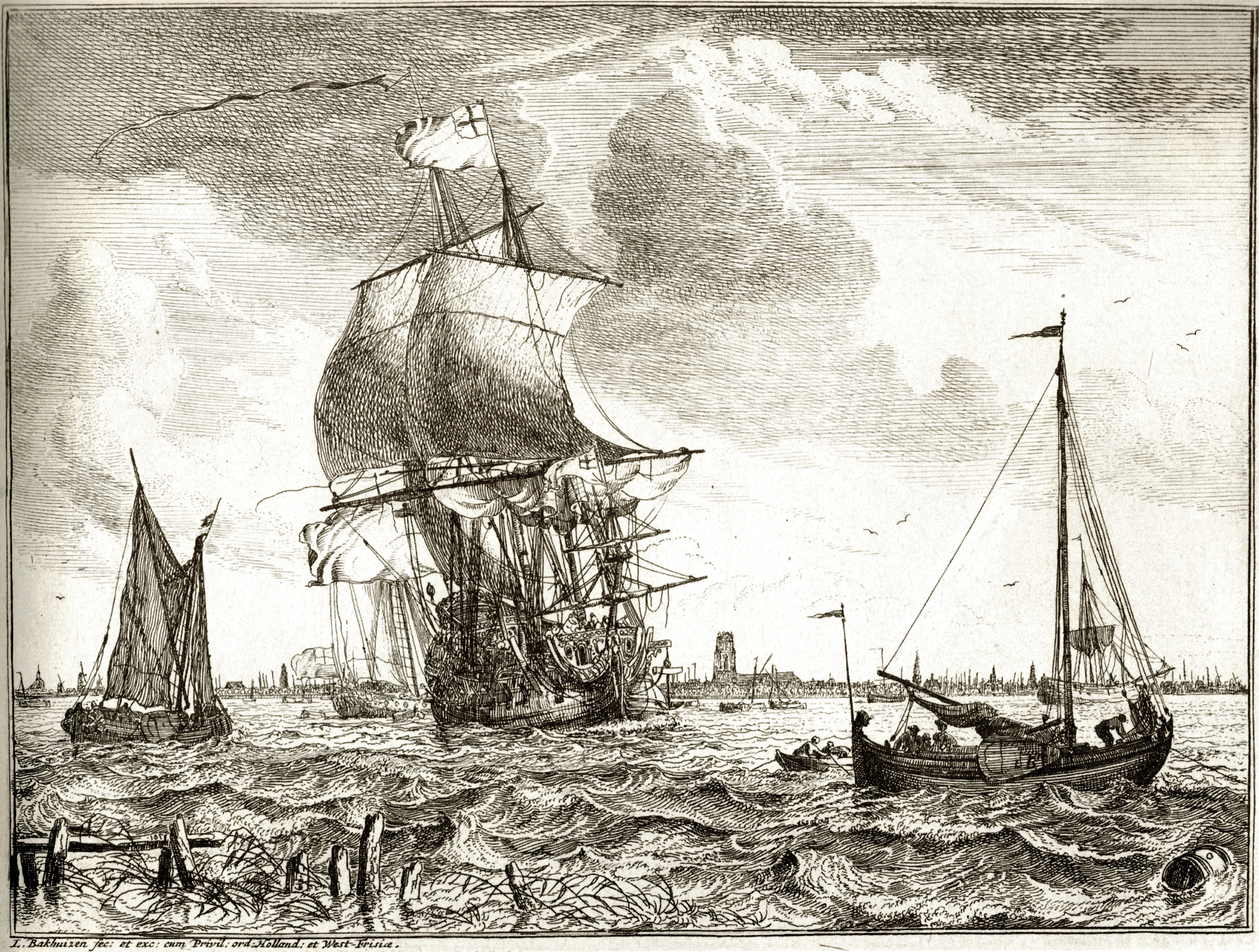
The Merchant Shipping Anchorage in the Texel with Texel Island and Oude Schild to the North West

The Merchant Shipping Anchorage in the Texel with Texel Island and Oude Schild to the North West

By Ludolf Bakhuizen

National Maritime Museum Greenwich

The setting for the picture is the merchant shipping roadstead off the eastern coast of Texel, one of a group of northern islands guarding the entrance to the Zuider Zee. Texel Island can be seen ahead with the village of Oude Schild to the far right. The channel between the islands into the North Sea is on the horizon beyond the merchant ship furthest left. A group of three large ships is shown in the middle distance. To the left is a fluyt under sail with a larger ship passing, hidden beyond and to the right. Further back, a Dutch warship lies at anchor. Another fluyt lies at anchor on the far right. In the foreground, a group of small craft, typical of Dutch inland waterways, is tossed about by the boisterous weather. On the left, a wijdschip, with a weyschuit or punter, is lowering its sail in the immediate foreground. Another wijdschip is seen from the stern under billowing canvas, under the stern of the fluyt. On the right a kaag, a common type of ferry boat, is running before the wind with sprit-rigged mainsail and foresail.

The artist has intentionally arranged a cross section of coastal craft in the painting to demonstrate the significance of the sea. Bakhuizen was initially a calligrapher in his native Germany before moving to Amsterdam. There, he was inspired by the grisaille drawings of van de Velde, the Elder. Later, he was introduced to marine painting in oils in the studios of van Everdingen and Dubbels. He was a contemporary of van de Velde, the Younger and shared with him a concern for painting ships with accuracy and understanding. The painting is signed.

continue reading.....

Italianate Harbour View with a Fantasy Building and Man-of-War

Published in January 9th, 2009
Posted by in Harbors
No Comments

Italianate Harbour View with a Fantasy Building and Man-of-War

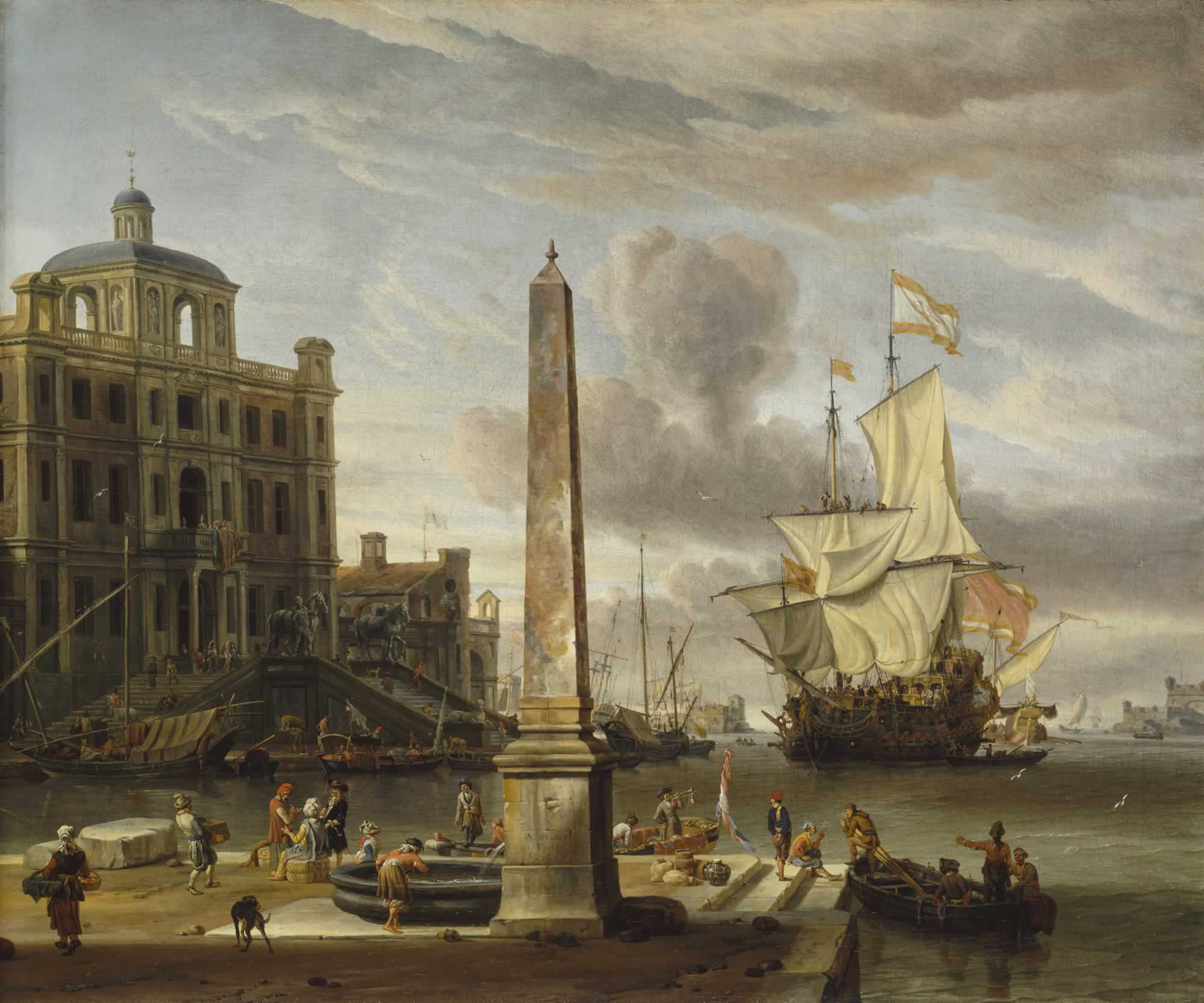
Although the quay in the foreground of this imaginary Italian port is dominated by an obelisk, the monumental staircase crowned by classical sculpture which leads to the building to the left draws the viewer’s attention. This palace is not a real building but the lantern on top is a direct reference to Amsterdam town hall. To the right an imposing two-decker enters the harbour. Storck’s work exudes the silvery atmosphere of a sunny morning in the Mediterranean.

continue reading.....

Italianate Harbour Scene with the Monument of Ferdinand I de’ Medici at Leghorn

Published in January 6th, 2009
Posted by in 17th Century, Harbors
No Comments

Italianate Harbour Scene with the Monument of Ferdinand I de’ Medici at Leghorn

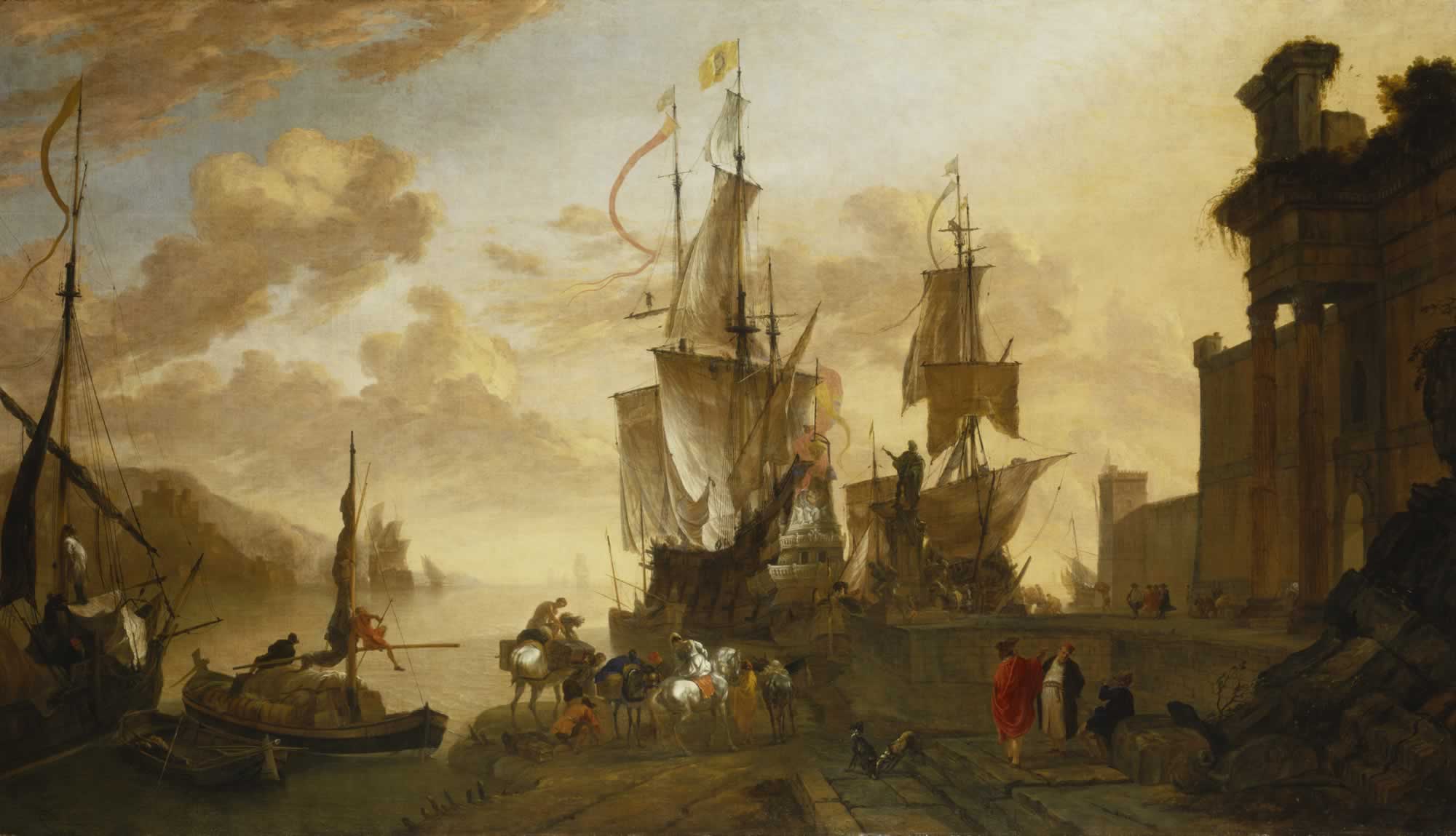
In this largely imaginary view of Leghorn, where tall ships tower over a quay, an elegant lady on a white horse is about to depart. Three figures, gesturing theatrically, are also conversing or haggling over business. On the quay is a statue of Ferdinand I de’ Medici, who made Leghorn a free port. The monument, which still stands, was completed between 1595 and 1626 by Giovanni Bandini and Pietro Tacca, and became a symbol of the city.

continue reading.....

Return of a Fleet into Plymouth Harbour

Published in May 24th, 2008
Posted by admin in 18th Century, Harbors, Royal Navy, Seven Years War
1 Comment

Return of a Fleet into Plymouth Harbour

RETURN OF A FLEET INTO PLYMOUTH HARBOUR

By Dominic Serres the Elder, 1766

(Highest resolution available 4102×2439)

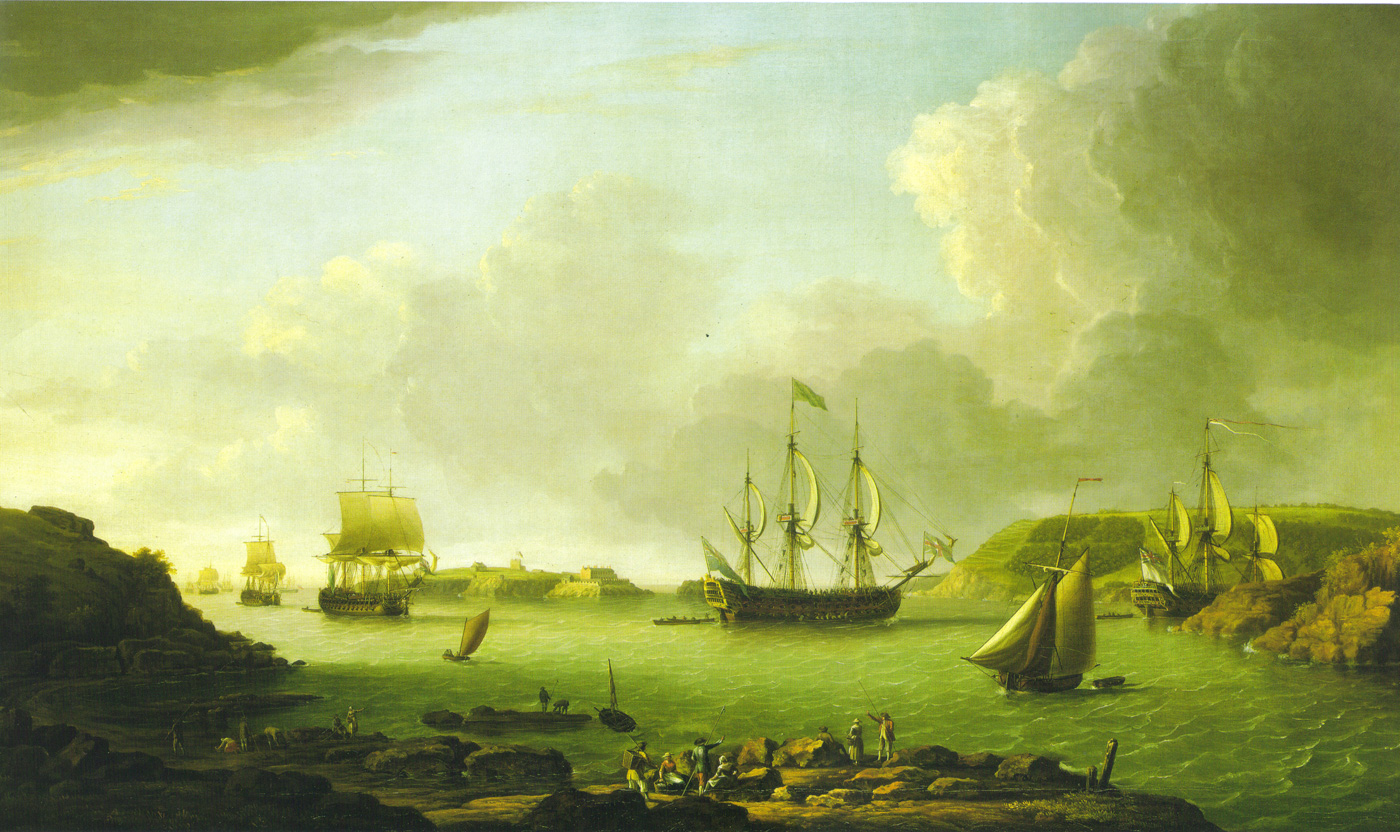
The recruited sailors had to be kept healthy. The circumstances required British ships to spend long periods of time at sea and in 1759 this problem was especially difficult. The French were planning an invasion of England and gathered their armies and transport craft at a wide and safe anchorage called the Morbihan. To start the invasion the French men-of-war  had to sail from the nearby Brest to Morbihan to collect the troops and escort the transport to the English shores. For the British it was critical to keep the French fleet on check and prevent it leaving Brest. Therefore a close and continuous watch was required. This meant that a fleet of 14,000 men had to be kept healthy at sea for weeks or even months in the western part of the Channel. Such a blockade was made possible by the existence of Plymouth dockyards, where damaged ships could return for running repairs. Also food, fresh water and other supplies could be easily sent to the blockading fleet. With Brest being the main target, Plymouth grew both in size and importance.

continue reading.....

View Of The ‘Pont-Neuf’ From The Corner Of The Ordnance Stores

Published in May 21st, 2008
Posted by admin in 18th Century, French Navy, Harbors
1 Comment

View on the \'Pont-Neuf\' from the corner of the ordnacne stores

VIEW OF THE ‘PONT-NEUF’ FROM THE CORNER OF THE ORDNANCE STORES

By Joseph Vernet, 1755

By 1750 France had only three working dry docks and none of them answered the growing needs of the French Marine. The double dock at Rochefort could not be accessed by any ship larger than the fourth rate because its position was too far up the narrow and winding Charente river, and the only other dry dock, that at Brest, had been poorly designed and would not dry out completely. There was a fabulous harbor and yard at Toulon in the Mediterranean, the subject of this picture but the Mediterranean is tideless which makes the design of dry docks extremely difficult. With no tide a dry dock cannot drain itself but must be pumped out, and it was not until 1774 that the Spanish solved the problem in their dockyard at Cartagena by installing a steam-driven pump. In the meantime French ships had to be careened – effectively pulled on their sides to expose their hulls. Moreover French ships had been built to escort merchantmen or capture enemy merchant ships rather than for fleet battles which were soon to be forced on them time and again by the resurgent Royal Navy.

This shows the ordnance stores of the Toulon dockyard. Lines of battleships are moored in the background, and in the foreground shot of every caliber are perfectly aligned. Some cannon are being cleaned while a group of officers and engineers hold a discussion.

continue reading.....

Social Network

  • Subscribe to the feed
  • Stumble this site main post
  • Add to my Technorati favourite

Feeds

18th Century, French Navy, and Harbors
July 2010
M T W T F S S
« Apr    
 1234
567891011
12131415161718
19202122232425
262728293031  

Recent Entries

  • The Eendracht and a Dutch Fleet of Men-of-War before the Wind
  • The Capture of Puerto Bello, 21 November 1739 by George Chambers, Senior 1836
  • Russian Black Sea Fleet on a Parade in 1849, by Ivan Aivazovsky
  • Dutch Ships in Distress off a Rocky Coast, Ludolph Backhuysen, 1667
  • The Raid on Chatham (Raid on Medway), 17-23 June 1667
  • Unsuccessful English attack on the VOC fleet at Bergen, 12 August 1665
  • The Battle of the Saintes, 12 April 1782
  • The Victory Leaving the Channel in 1793
  • Battle of Livorno (Leghorn), March 14 1653
  • Bombardment of Algiers by Anglo-Dutch Forces on August 26-27, 1816

Recent Comments

  • admin in Battle of Scheveningen (Ter Heide) …
  • Karel in Battle of Scheveningen (Ter Heide) …
  • hobrah in The First Post And The First Painti…
  • » Russian… in Battle of Sinop (The Day), 18 Novem…
  • » The Rai… in Lieutenant-Admiral Michiel de Ruyte…
  • smadaluap in The First Post And The First Painti…
  • HUILLE (Jean-Ma… in View Of The 'Pont-Neuf' From The Co…
  • dutchprovence in The Frigate "De Ploeg" on the Ij in…
  • ZI in Battle of Scheveningen (Ter Heide) …
  • Pauld in The First Post And The First Painti…

Categories

  • 17th Century
  • 18th Century
  • 19th Century
  • Battle Scenes
  • Drawings
  • Dutch Navy
  • First Anglo-Dutch War
  • French Navy
  • French Revolutionary War
  • Harbors
  • Ludolf Backhuysen
  • Portraits
  • Royal Navy
  • Russian Navy
  • Second Anglo-Dutch War (1664–67)
  • Seven Years War
  • Third Anglo-Dutch War
  • Uncategorized
  • Unidentified Paintings
  • War of American Independence
  • Willem van de Velde the Elder
  • Willem van de Velde the Younger

Translators

French German version Spanish version Italian version

Meta

  • Log in
©2008 History of the Sailing Warship in the Marine Art