• Home
  • About

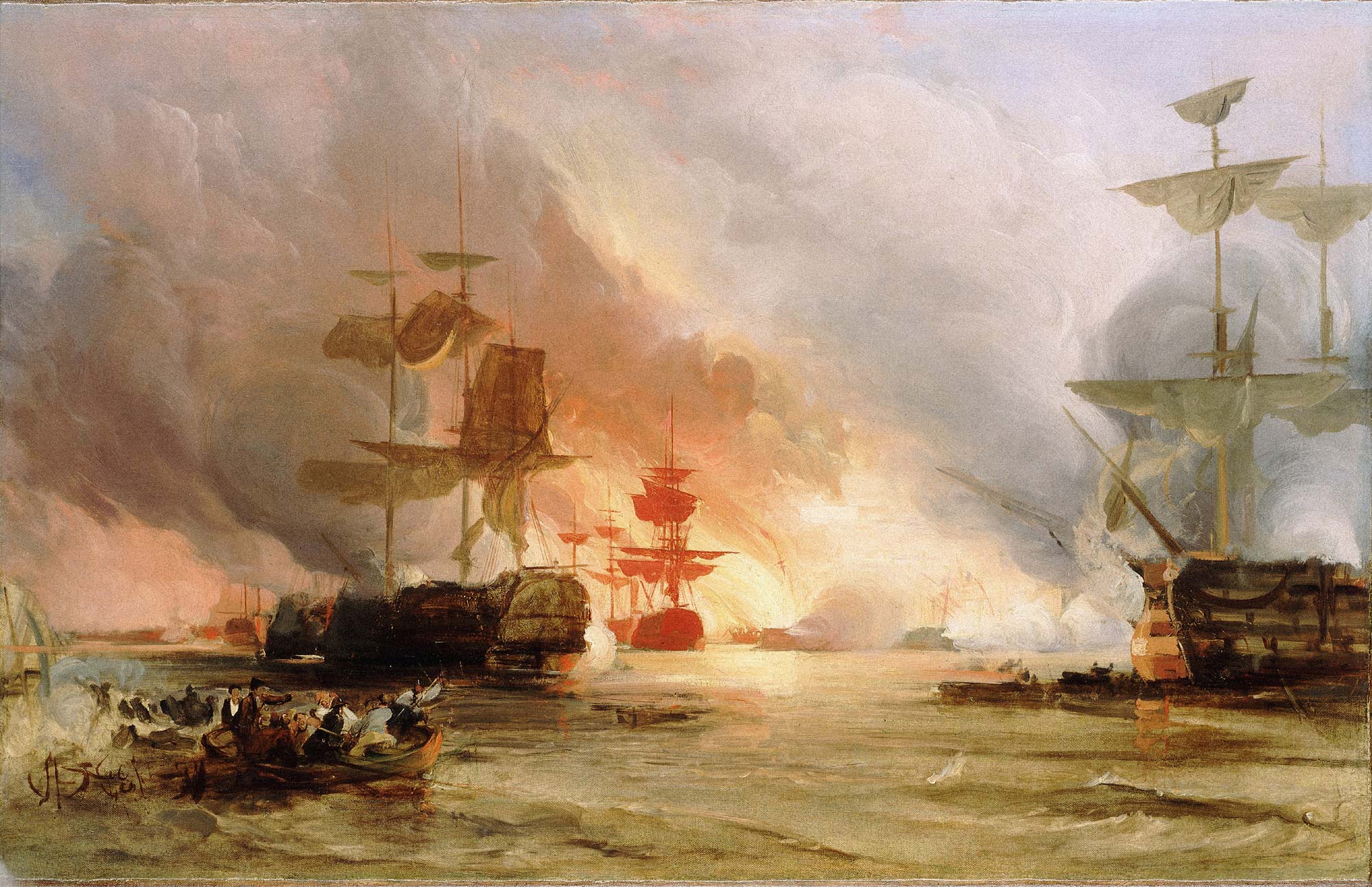
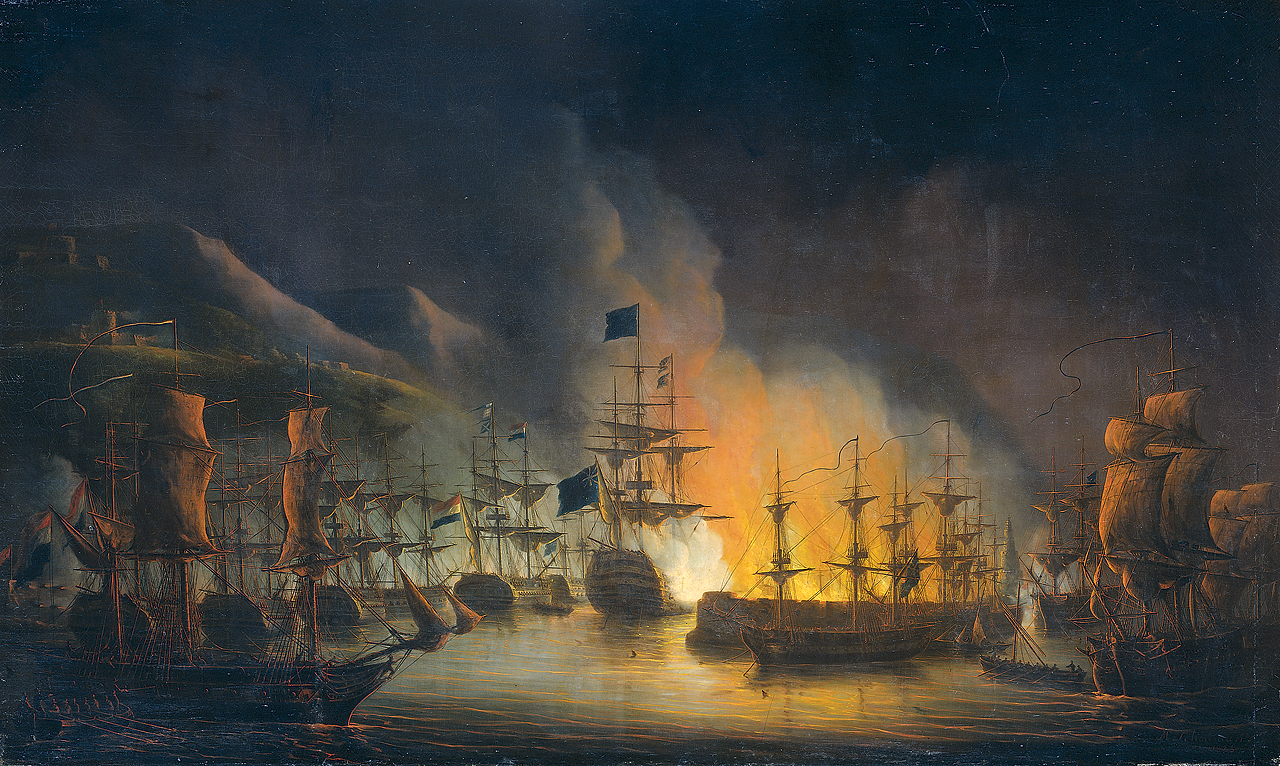
The Bombardment of Algiers 27 August 1816 by George Chambers, Senior

Published in October 24th, 2010
Posted by admin in 19th Century, Battle Scenes, Dutch Navy, Royal Navy
No Comments

The-Bombardment-of-Algiers-27-August-1816-by-George-Chambers-Senior

The Bombardment of Algiers 27 August 1816 by George Chambers, Senior, ca 1836

National Maritime Museum, Greenwich

(image 1500 x1063 px, 728 KB)

The Bombardment of Algiers by the combined Anglo-Dutch force under the command of Sir Edward Pellew has already been described in details in an earlier post. This time I would like to present a view of this battle as painted by George Chambers, Senior.

For his actions Admiral Pellew had been raised to Viscount and several of his friends and associates had subscribed 200 guineas to commission a painting commemorating this victory. The Secretary and Commissioner of the Greenwich Hospital E.H. Locker (a former secretary to Admiral Pellew) had played an important part in awarding the contract to George Chambers, from whom he had previously obtained an oil painting for inclusion into the Naval Gallery at the Hospital.

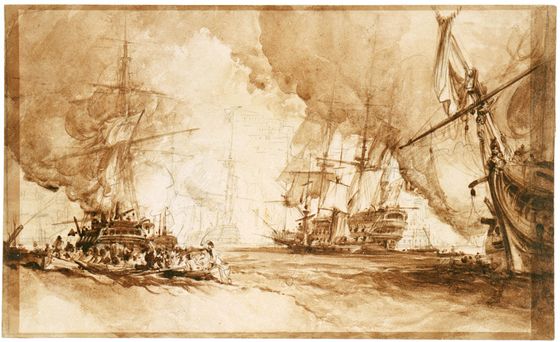
This painting is George Chambers’ the most important late work and in addition to it the National Maritime Museum in Greenwich has a number of sketches and a preliminary oil study that is also presented in this post.

In the right foreground of the painting a massive bow of the Impregnable, 98 guns, shelters a number of boats armed with carronades. In the left foreground a boat commanded by a lieutenant is about to fire its howitzer.

In the left foreground more boats are seen beside the stern of the Minden, 74 guns. One of these boats is armed with Congreve rockets. The Minden is firing her starboard guns. Behind her is the Superb, 74 guns.

In the left background the Dutch flagship Melampus is seen, starboard side.  In the middle Chambers painted Pellew’s flagship the Queen Charlotte, 100 guns, in a quarter port view. Beyond her one can see a glimpse of the Leander, 50 guns.

The Algerian coastal batteries are under heavy fire from the Anglo-Dutch ships and are covered in flames and smoke. Behind the batteries the masts of Algerian ships in the harbor are seen.

Oil study to The Bombardment of Algiers 27 August 1816 by George Chambers, Senior , ca 1836

National Maritime Museum, Greenwich

(image 2000 x 1293 px, 459 KB)

Before painting this work George Chambers visited Plymouth where he made sketches of men-of-war. In this preliminary oil study he created the layout for his main work. Although this painting lacks details it has an intense atmospheric impression.

A sketch to The Bombardment of Algiers 27 August 1816 by George Chambers, Senior, ca 1836

continue reading.....

Russian Black Sea Fleet on a Parade in 1849, by Ivan Aivazovsky

Published in April 12th, 2010
Posted by admin in 19th Century, Russian Navy
No Comments

Russian Black Sea Fleet on a Parade

Russian Black Sea Fleet on a Parade in 1849, by Ivan Aivazovsky, 1886

Central Naval Museum of Russia in Saint Petersburg

(image 2103×1200 pixels 412KB)

Russian Black Sea Fleet ships of the line on a parade – an impressive display of naval might captured by Ivan Aivazovsky in the last years of the sailing warship’s rule over the seas. In 1849 Emperor Nicolas I of Russia was reviewing his forces in the Black Sea. At that time the Black Sea Fleet was the most potent, most well organized, trained and technically advanced force in the arsenal of the Russian Empire. This achievement is owed much to Admiral Lazarev, commander of the Black Sea Fleet in 1834-51. In the years of his administration he had significantly improved the organization and personnel training; and the fleet had been receiving as much modern weapons and technology as limited Russian industry’s resources could allow. Under his tutorship a number of talented and energetic offices raised to prominence: Admirals Kornilov, Nakhimov, Istomin and Butakov.

The results of Admirals Lazarev’s work are clearly seen on this painting. The line is headed by 120-gun Twelve Apostles, the most modern ship of the fleet launched in 1841 and armed with shell guns. Behind him are 84-gun Rostislav, Svyatoslav and Yagudiil, 120-gun Tri Svyatitelya, and presumably 84-gun Gavriil, Selafail and  Uriil. The observer finds himself on board of paddle frigate Vladimir, one of the few steam powered ships in the fleet. The officers on deck are Emperor Nicolas I, Rear-Admiral Kornilov (Head of the Fleet Staff),  Grand Duke Constantine (Emperor’s brother), Rear-Admiral Berkh (Commander of the Sebastopol naval base)  and Admiral Lazarev (Commander of the Fleet).

Some of the ships shown here later had successfully fought the Turks in the Battle of Sinop but none of them survived the Crimean war. The rapid technology progress made the sailing ship of the line obsolete. Steam powered warships of Britain and France no longer depended on ever changing winds, and any attempt of Russian ships to confront them would have been suicidal. The tactical advantage of maneuvering under steam proved to be of a strategic value: after Sinop there were no more major engagements involving purely sailing warships.  These graceful ships ended up scuttled on the bottom of the Bay of Sebastopol.

This painting is on display in the Central Naval Museum of Russia, Saint Petersburg.

continue reading.....

Bombardment of Algiers by Anglo-Dutch Forces on August 26-27, 1816

Published in January 25th, 2010
Posted by admin in 19th Century, Battle Scenes, Dutch Navy, Royal Navy
1 Comment

The bombing of Algiers, to support the ultimatum to release white slaves, 26-27 augustus 1816
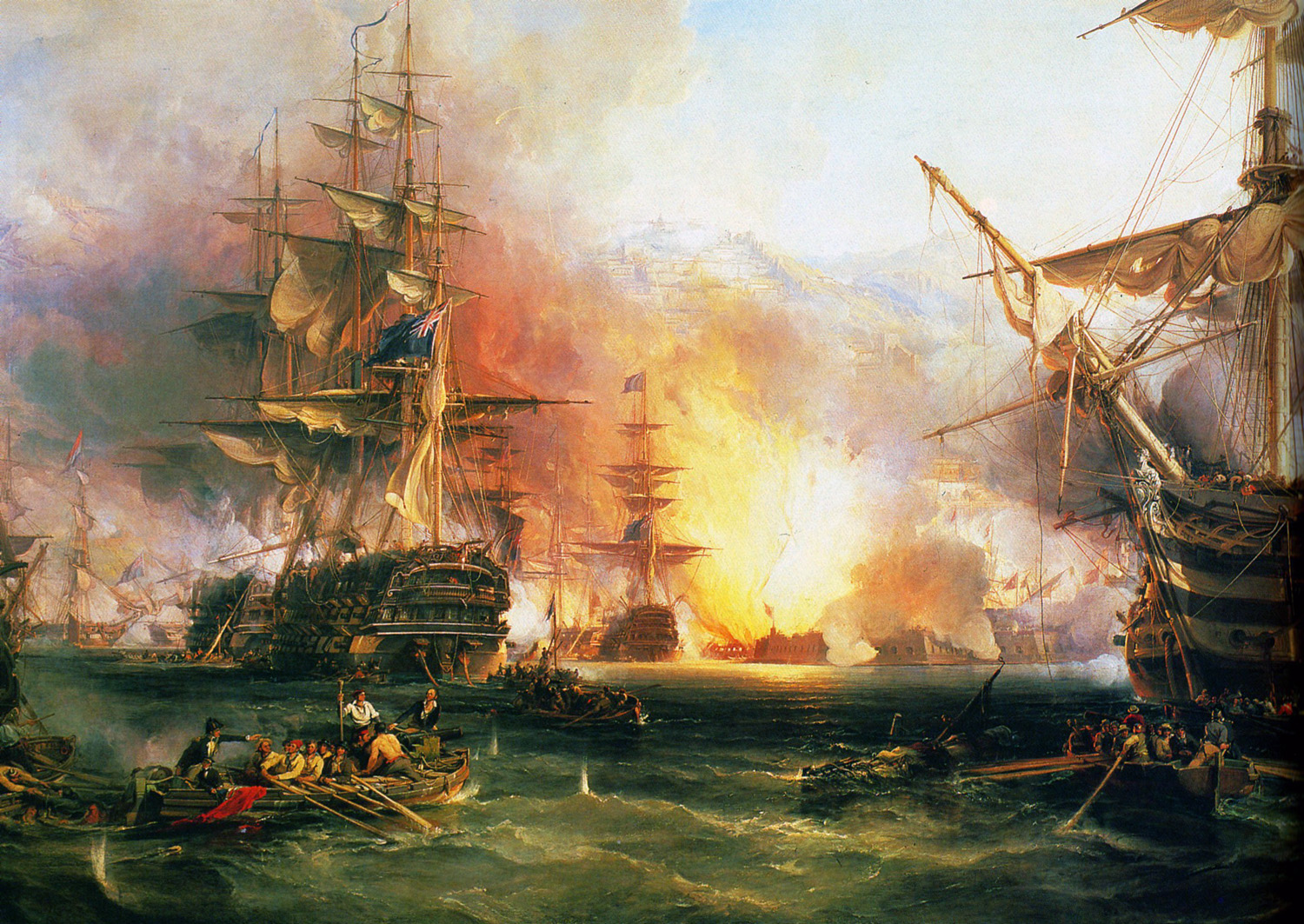
Bombardment of Algiers, to Support the Ultimatum to Release White Slaves, August 26-27 1816, painted in 1823 by Martinus Schouman on orders of Ministerie van Marine

Rijksmuseum Amsterdam

These two paintings depict episodes of a joint Anglo-Dutch action against Barbary States in 1816. For centuries the forces of North African monarchies have been raiding the shores of Christian Europe capturing fishermen, looting coastal villages and town; sometimes reaching as far as to England, Ireland and even Iceland. Slaves were captured to be sold on markets in Algiers and Tunisia. European maritime powers responded with punitive expeditions but did not completely succeed to stop the slave trade in North Africa until the French colonization in mid. 19th century.

One of such expeditions took place in summer of 1816. Following the end of Napoleonic Wars England no longer depended on supplies purchased in Algiers for her Mediterranean Fleet. Besides there was considerable political support for action against Barbary pirates and slavers. In 1816 a squadron led by Admiral Sir Edward Pellew, 1st Viscount Exmouth managed to convince Dey of Algiers to sign a treaty to stop the white slave trade. However, due to misread orders Algerian troops massacred Sicilian and Corsican fishermen who were under British protection. This caused an outrage in England and elsewhere in Europe, and Admiral Pellew was ordered to punish the Algerians.

In August 1816 a squadron of five ships of the line, one 50-gun ship and four frigates sailed out and was joined in Gibraltar by a Dutch force of five frigates and a corvette commanded by Vice-Admiral Theodorus Frederik van Capellen.

Algiers was well defended by shore batteries whose destruction was to be the first objective for the allies. Algerians planned to let the enemy ship close to the mole without firing at them and then to border them with large number of men in small boats.

On August 27 1816 the allied force reached Algiers. The action started at 3:15PM when due to the lack of discipline one Algerian cannon fired a shot at the British ships. This was immediately answered with a hail of fire. Algerian boarding attempt failed and 33 of their boats were sunk. By 7:30PM most of the coastal artillery was silenced and the Allies started firing at the shipping in the port. At 8:00PM a British bomb vessel exploded following a navigational error when trying to bear its guns against a shore battery. The action was over when at 10:15PM the British weighed anchor and sailed away. HMS Minden kept suppressive fire until 1:30AM and by this time the allied squadron anchored out of range.

The action was intense and the British had 818 men killed and wounded – 16% casualties. Algerians reportedly lost around 7000 men.

The following day Pellew sent a peace offer threatening to continue bombardment. This was a bluff as the British were almost out of ammunition. The Dey, however, accepted the terms and freed 1083 Christian slaves and repaid the ransom money.
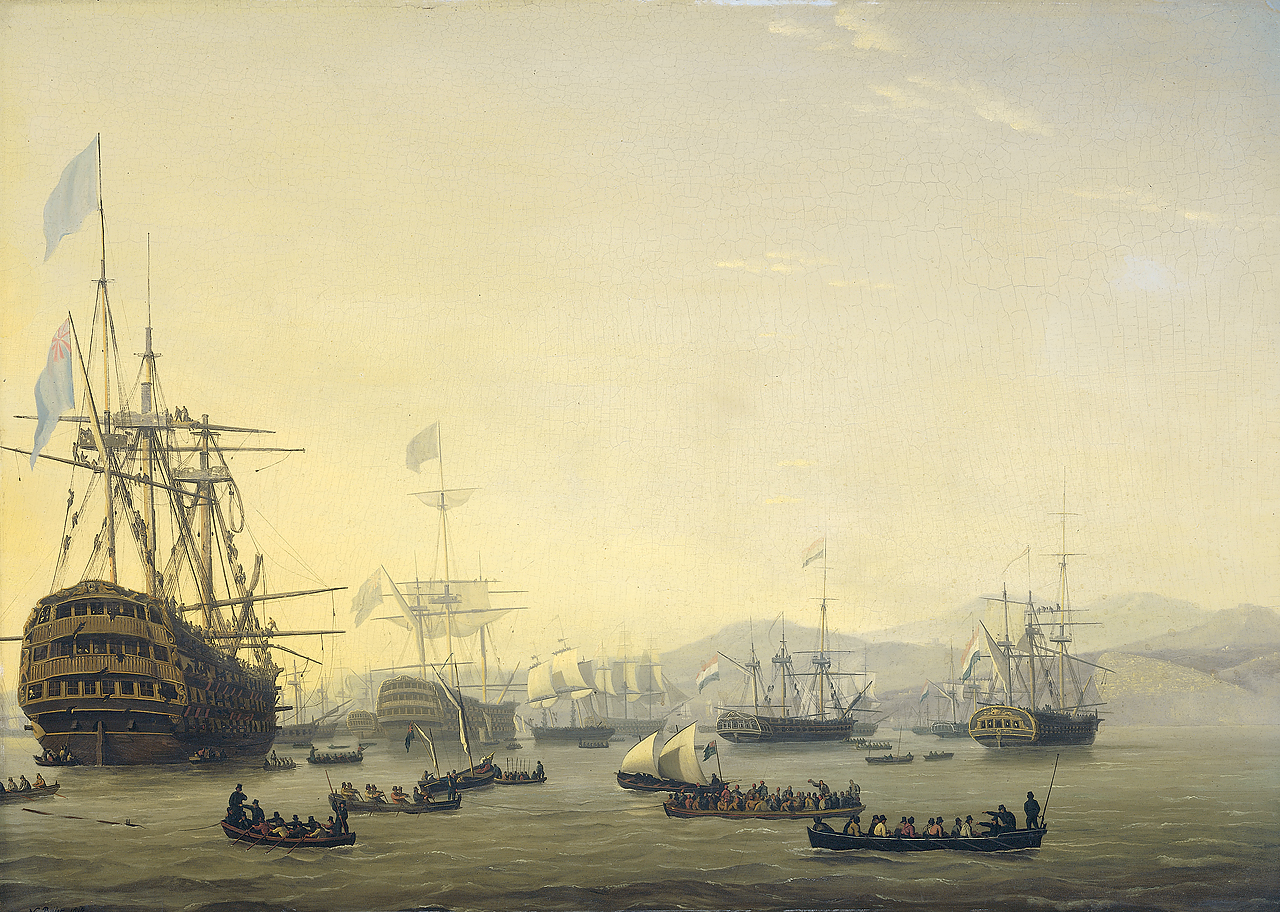
Council of war aboard the 'Queen Charlotte' held by Lord of Exmouth before the bombing of Algiers, August 26, 1816

Council of War Aboard the ‘Queen Charlotte‘ Held by Lord of Exmouth before the Bombardment of Algiers, August 26, 1816, by Nicolaas Baur 1848.

Rijksmuseum Amsterdam

Special thanks for the idea and materials for this post to Edwin from Holland
continue reading.....

Battle of Sinop (The Day), 18 November 1853

Published in April 29th, 2009
Posted by admin in 19th Century, Battle Scenes, Russian Navy
1 Comment
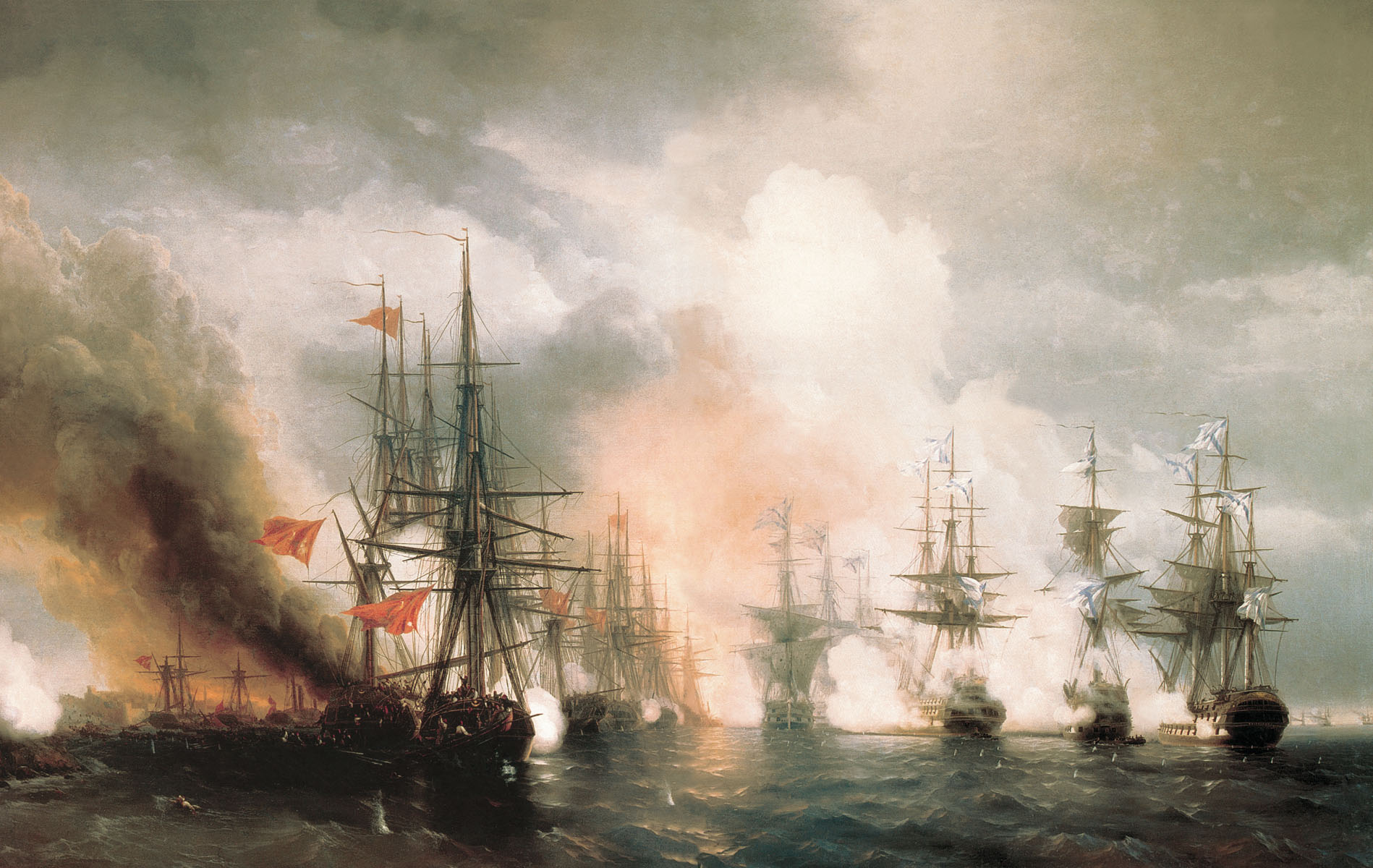
Battle of Sinop (The Day)

Battle of Sinop (The Day)

By Ivan Aivazovsky

The last major naval engagement of the age of sail (Battle of Sinop) can be seen on this painting by Ivan Aivazovsky. In November 1853 a Russian squadron commanded by Vice-Admiral Pavel Nakhimov (3 84-gun ships) was on patrol off the northern coast of Anatolia. Russian ships approached the Bay of Sinop to check the rumors of the Turks gathering a landing force there. A squadron of 7 Turkish frigates and 5 smaller ships was anchored in the bay protected by 6 coastal batteries. Nakhimov’s force blockaded the port and waited for reinforcements to come. Soon 3 120-gun ships of the line and 2 frigates commanded by Rear-Admiral Novosilsky joined Nakhimov. Fearing that the Anglo-French fleet might reinforce the Turks the Russians decided to attack.

The Russian fleet sailed down to Sinop in two columns. The ships of the line were armed with a new and formidable weapon: the Paixan 68-pounder shell guns, which were especially deadly against wooden warships. On 18 (30) November 12:30 PM the action began. The Russians took position in a crescent along the anchored Turkish ships and started firing. A fierce cannonade from the Turkish batteries and ships inflicted some serious damage on the Russian fleet, but still the Turkish frigates were no match to the shellfire of the bigger guns of the Russian ships of the line.  In slightly more than an hour all the Turkish ships were either destroyed or ran aground. By 4 PM the batteries were silenced as well. Only one Turkish steamer escaped the carnage.

continue reading.....

A Trinity House Yacht and a Revenue Service Cutter off Ramsgate

Published in May 29th, 2008
Posted by admin in 18th Century, 19th Century, Royal Navy
No Comments

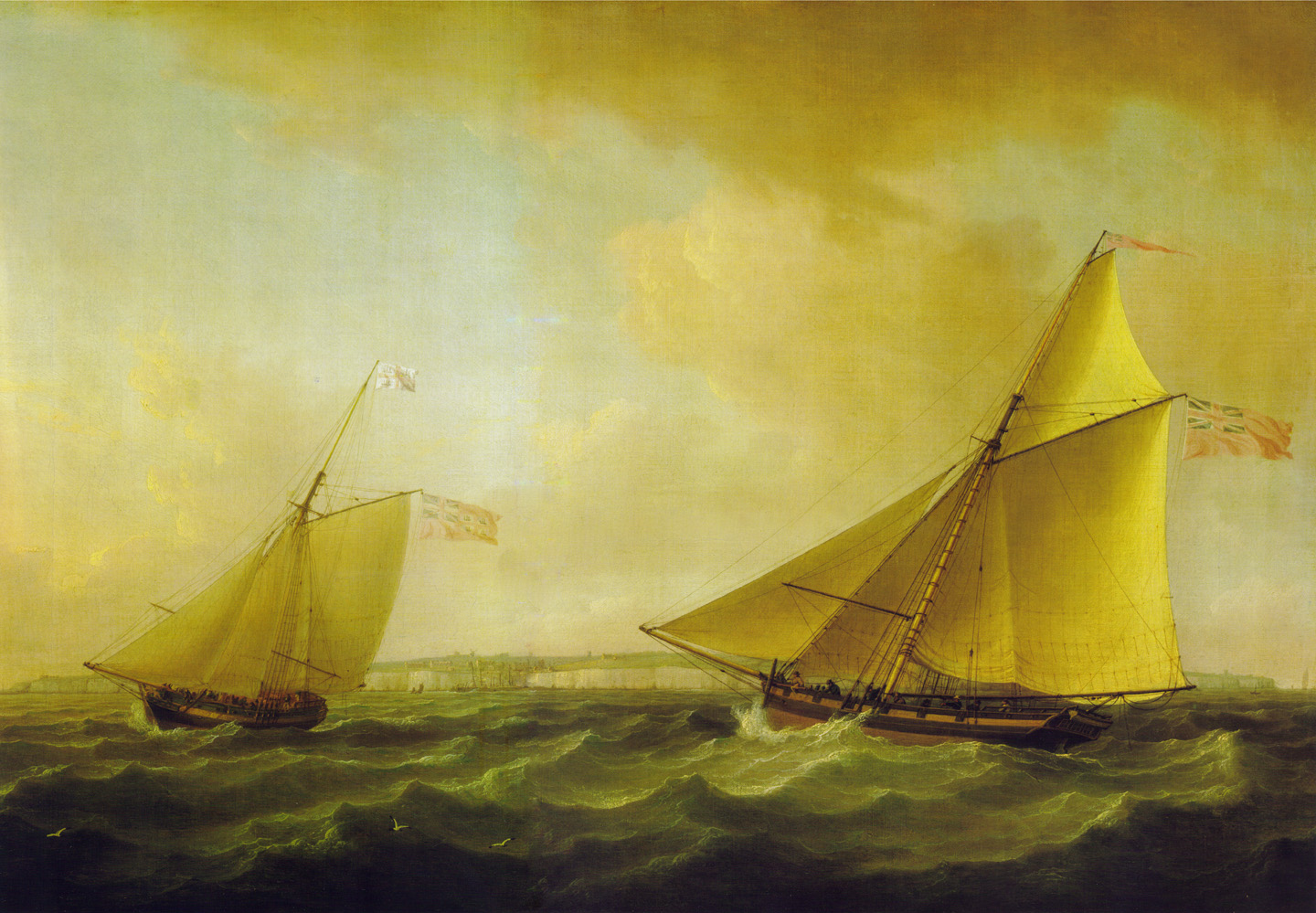
A Trinity House Yacht and a Revenue Service Cutter off Ramsgate

A TRINITY HOUSE YACHT AND A REVENUE SERVICE CUTTER OFF RAMSGATE

By Thomas Whitcombe, c.1810

(Highest resolution available 5914×4103)

The decade of peace between the Seven Years War and the beginning of the War of American Independence saw a greater focus on domestic maritime problems, chief among which was smuggling. The long-established national taste for expensive wars imposed a financial burden which fell largely on the public. They were faced with heavy taxes on a bewildering array of goods, both exported and imported, and this led directly, quickly and inevitably to an explosion in smuggling. In wartime smugglers flourished with few men of ships to spare to guard the coasts, but during the peacetime everything changed. After the Seven Years War the Revenue Service expanded dramatically in both number and size of its ships. The vessel on the right is an armed revenue cutter. By 1773 there were 29 such vessels in service, and by the end of the War of American Independence there were 42, employing over 1000 men. Armed cutters were designed and built specifically to counter the threat of the smugglers. Fast and handy, they were built with shallow draughts which allowed them to penetrate deep inland.

While the Revenue Service was responsible for the security of Britain’s borders, Trinity House was responsible for their safety. The lighthouses, lightships and navigational marker buoys around the English coasts were all owned and run by Trinity House. The vessel on the left is a Trinity House yacht.

Source ID: #fghtshpsv2#

continue reading.....

Social Network

  • Subscribe to the feed
  • Stumble this site main post
  • Add to my Technorati favourite

Feeds

18th Century, 19th Century, and Royal Navy
May 2013
M T W T F S S
« Apr    
 12345
6789101112
13141516171819
20212223242526
2728293031  

Recent Entries

  • An English Ship with Sails Loosened Firing a Gun, by Peter Monamy
  • Two Engravings by Ludolf Bakhuizen
  • Boats in a Harbour and a Yacht Sailing Away by Willem van de Velde the Younger
  • The Merchant Shipping Anchorage Southwest of Texel, by Ludolph Backhuysen
  • Ships in the Roads of Amsterdam by Ludolph Backhuysen
  • The Loss of the Royal George by John Christian Schetky
  • The Bombardment of Algiers 27 August 1816 by George Chambers, Senior
  • The Explosion of the Spanish Flagship in the Battle of Gibraltar April 25th 1607 by Cornelis Claesz van Wieringen
  • Dutch Whalers off a Rocky Coast
  • The Dutch Fleet under Sail

Recent Comments

  • amberlu in The Victory Leaving the Channel in …
  • admin in The Merchant Shipping Anchorage Sou…
  • nescio in The Merchant Shipping Anchorage Sou…
  • Bettylene W. Fr… in Harrison's H4 Chronometer, 1760
  • ernie in The Raid on Chatham (Raid on Medway…
  • Diana Barron in Boats in a Harbour and a Yacht Sail…
  • kepler in The surrender of Prince Royal at th…
  • Bizuvnot in A Dutch Flagship Coming to Anchor w…
  • Bizuvnot in A Ship in High Seas Caught by a Squ…
  • grampahoney in A Ship in High Seas Caught by a Squ…

Categories

    • 17th Century
    • 18th Century
    • 19th Century
    • Battle Scenes
    • Drawings
    • Dutch Navy
    • First Anglo-Dutch War
    • French Navy
    • French Revolutionary War
    • Harbors
    • Ludolf Backhuysen
    • Portraits
    • Royal Navy
    • Russian Navy
    • Second Anglo-Dutch War (1664–67)
    • Seven Years War
    • Third Anglo-Dutch War
    • Uncategorized
    • Unidentified Paintings
    • War of American Independence
    • Willem van de Velde the Elder
    • Willem van de Velde the Younger

Translators

French German version Spanish version Italian version

Blogroll

  • marine oil paintings - marine oil paintings
©2008 History of the Sailing Warship in the Marine Art